
Sometimes US politicians blurt out the truth. Recently Mitch McConnell stated that: ” Most of the money that we spend related to Ukraine is actually spent in the US, replenishing weapons, more modern weapons. So it’s actually employing people here and improving our own military for what lies ahead.”
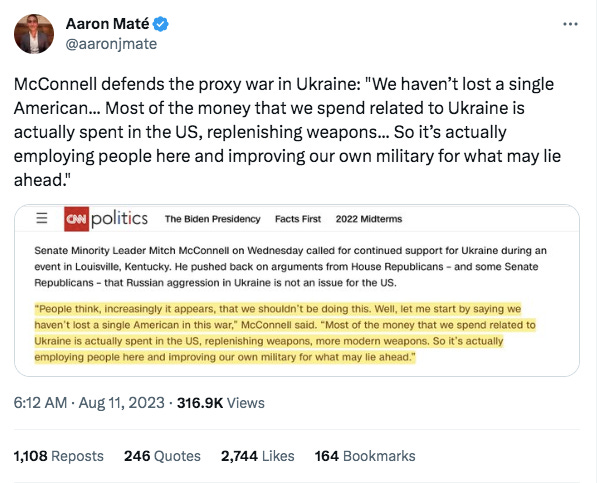
So that whole narrative about defending Ukraine from “unprovoked” Russian aggression is just a cover story to disguise the real purpose, which is feeding the military/industrial/complex. Gee, who could have known?
War really is the health of the state. Sorry. The health of the deep state. The US is an empire that wages wars to maintain control, managed by a national security class, who’s members are never on the ballot. That permanent government structure is why the large-scale movements of the empire don’t change when a president is replaced by a new president from Team Red or Team Blue. America’s official elected government may have changed, but the real government that manages the empire did not.
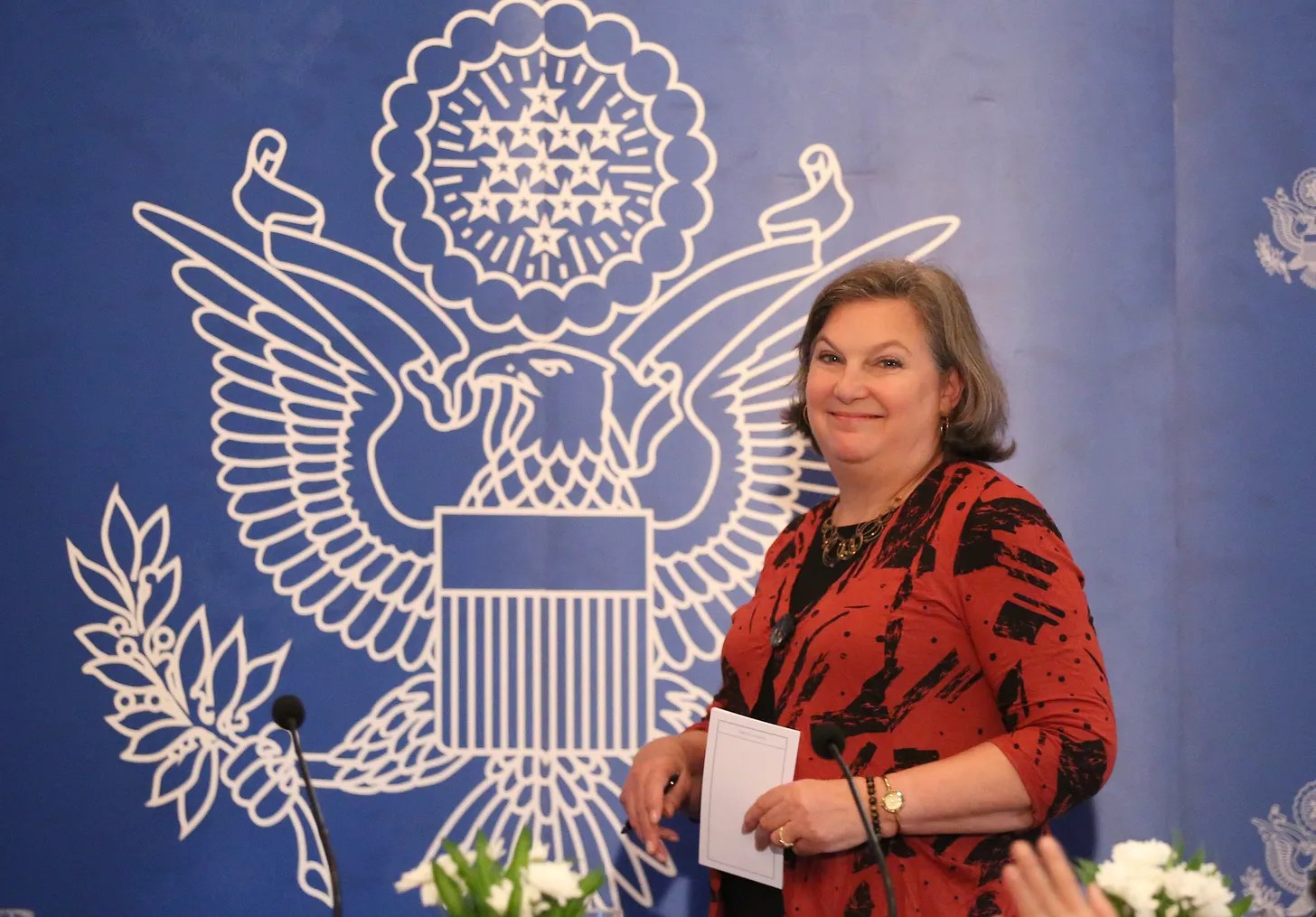
This is a big part of what keeps the American empire acting the same way from administration to administration. Every president is stage managed by DC swamp monsters, like Victoria Nuland, who all went to the same universities and moved through the same revolving door employment circles of government agencies and think tanks and party politics and military-industrial complex advising/lobbying and media punditry, who all understand what’s required of the US president to facilitate the perpetuation of the American empire.
All of this was set in motion decades ago when the US established a policy of ensuring that no other rival superpowers emerge after the fall of the Soviet Union. US foreign policy in the 2000s emphasized giant overt ground invasions (Iraq, Afghanistan). In the 2010s it shifted emphasis to arming proxies (Yemen, Libya, Syria). In the 2020s it upped the ante by staging massive proxy conflicts on the borders of its top two rivals (Ukraine-Russia, Taiwan-China).
Just to give you an idea of how much mayhem we’re talking about–the United States launched at least 251 military interventions between 1991 and 2022. This is according to a report by the Congressional Research Service, a US government institution that compiles information on behalf of Congress. The Military Intervention Project added: “With the end of the Cold War era, we would expect the US to decrease its military interventions abroad, assuming lower threats and interests at stake. But these patterns reveal the opposite – the US has increased its military involvements abroad.”
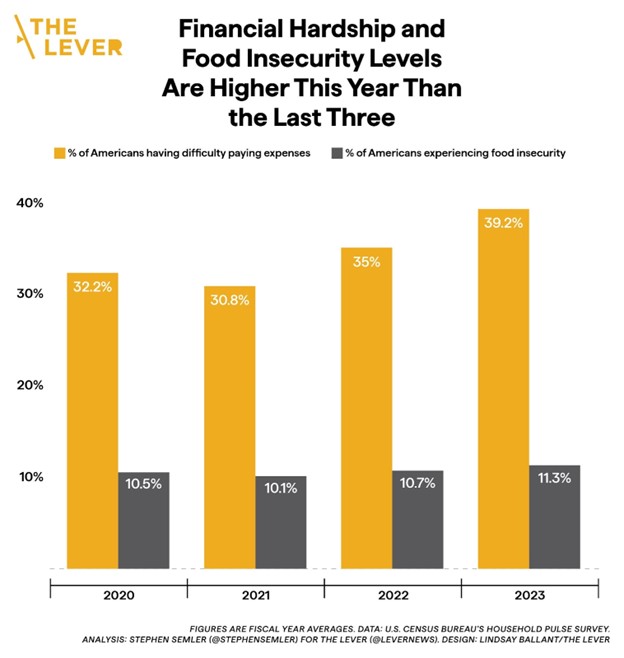
And while war is the health of the deep state, for the American people it’s an ongoing disaster. For the first time under the Biden administration, food insecurity rates eclipsed 12 percent, marking a fourth consecutive month of increase. What’s more, average financial hardship and food insecurity rates this year exceed the previous three.
The temporary welfare superstructure erected for the pandemic is being dismantled with nothing to replace it, leaving tens of millions of Americans in the lurch. This wasn’t supposed to happen. Democrats and the Biden Administration led voters to believe that they wouldn’t be left high and dry — as the emergency benefits expired, they should have been replaced with permanent ones.
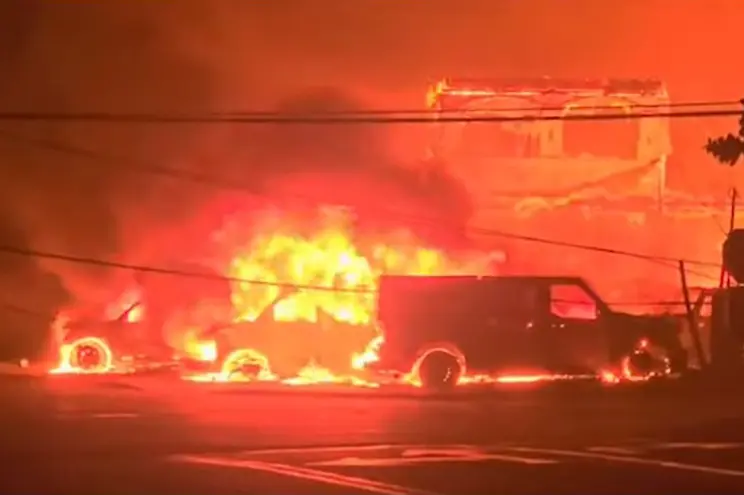
Meanwhile, it’s hard to look at recent footage of the devastation in Maui and then hear President Biden tell Congress that he needs another $24 billion for Ukraine.
Update: More honesty from US officials.
Last month The Washington Post’s David Ignatius wrote an article explaining why westerners shouldn’t “feel gloomy” about how things are going in Ukraine, writing the following about how much this war is doing to benefit US interests overseas:
“Meanwhile, for the United States and its NATO allies, these 18 months of war have been a strategic windfall, at relatively low cost (other than for the Ukrainians). The West’s most reckless antagonist has been rocked. NATO has grown much stronger with the additions of Sweden and Finland. Germany has weaned itself from dependence on Russian energy and, in many ways, rediscovered its sense of values. NATO squabbles make headlines, but overall, this has been a triumphal summer for the alliance.”
 camelotkidd