
We live in a interregnum, where everything, including reality itself, is in flux.
The paranoia and distrust of institutions that has taken hold in America is not a function of Donald Trump’s rancid populism no matter what the liberal, intellectual class may believe. The paranoia and distrust are a distillation of 40 plus years of neoliberalism, an economic and political project that funneled obscene wealth to the oligarchy as it impoverished the majority of Americans. The neoliberal consensus has for decades been utterly corporate, elitist, and narrow-minded to the exclusion of structural, nation-building policies that benefit working people, like Medicare for All or the return of American manufacturing from abroad. As a result the country is no longer capable of providing a good life for many of its citizens. In this light, we see a far more interesting picture emerge, where the rampant paranoia that is consuming the American body politic is the result of the capture and repurposing of the US government, combined with the extreme and accelerating decay of the American empire.

Trump is not going to “make America great again”. That ship has sailed. What needs to be done to make it happen are serious policies that our feral elite will hate. These, including real industrial policy and a collapse of asset prices and rent, plus increases in real wages, are anathema to America’s elites, and which, in any case, they are incompetent to implement. What we have instead is a corrupt political system and their resulting failure to deliver the kind of decent, improving living standards for its people that was once the basic idea of the American dream. I mentioned this before but it bears repeating. An April poll of voters aged eighteen to thirty by the Democratic-aligned Blueprint firm found that, in the words of its lead pollster, young voters look at US politics and “see a dying empire led by bad people”.
It’s hard to argue with that appraisal.
The elephant in the room is the American empire. The latest, “most important election ever” was characterized by the refusal of the candidates or the corporate media to even broach the subject, let alone suggest ways that the United States can rationally deal with the decline of its own empire. The reality is that American elites are engaged in a combination of denial and desperate pretense.

The recent authorization of missile strikes into Russia illuminate the risks those devoted to prolonging the imperium’s final phase will take in defense of the no-longer-defensible: All risks are acceptable as they cling to power. They will risk another world war; they will risk nuclear annihilation.
I never thought US leaders were capable of transitioning from a unipolar world to a multipolar one, just like I never thought they would be able to manage climate change. In fact it was never difficult to foresee that those planning and executing U.S. foreign policy, being second rate leaders influenced by a coterie of insane neocons, would prove incapable of an orderly transition to a multipolar world order. Increasing chaos and violence is baked in at this point, as recent events have made abundantly clear.
The loss of the American empire calls into question all of our political and economic actors. How does American corporate capitalism operate absent the US empire? I hate to quote Thomas Friedman but he has a point when he describes the US military as the backstop to American business. “The hidden hand of the market will never work without a hidden fist — McDonald’s cannot flourish without McDonnell Douglas, …”

Still, change is coming and it behooves us to imagine a future where the US is normal country instead of a global hegemon, circling the globe with military bases. And on that note, Michael Hudson and Richard Wolff had a fascinating discussion recently that deserves our attention.
RICHARD WOLFF: “Yes, I want to throw an idea out for you and for Michael to play with. And I’ll be blunt, so I won’t be able to develop the nuances of this. A very short time ago the head of Apple, Mr. Cook, went on a trip to China. He’s made many trips to China but more than one this year, but he recently made one. And it was crystal clear by the very warm reception he got, and by his own very enthusiastic, positive commentary on China, that – and here comes the jump – that there are sections of America’s most important, biggest businesses that do not want a war with China. They do not want this conflict. They have become the giant successes they have been because of what China enabled them to do. They know it. They don’t want to lose that. There is nothing to substitute for what they get out of China which, to be blunt, is cheap labor and the biggest expanding market on earth. To give those up is to risk their entire business operation.
Okay, now at some point – especially were Mr. Trump to win – these people are going to possibly begin to think like Michael just spoke. They’re going to say, These two parties are a disaster. They are involving us in one dead-end war, or conflict, after another. And while it may be good for the Military Industrial Complex, we are after all a bigger section of this economy than they are: we, the high tech industries; we, all the rest of the economy, other than the Military Industrial Complex.
At which point an immense conflict breaks out in the ranks of capitalists: Those who want to cut a deal with China and the BRICS work out how we live and let live with one another on this planet; who don’t want war and who don’t want nuclear war and who don’t want Jake Sullivan-type people playing around that problem – versus the Military Industrial Complex and those who are won over by them.”
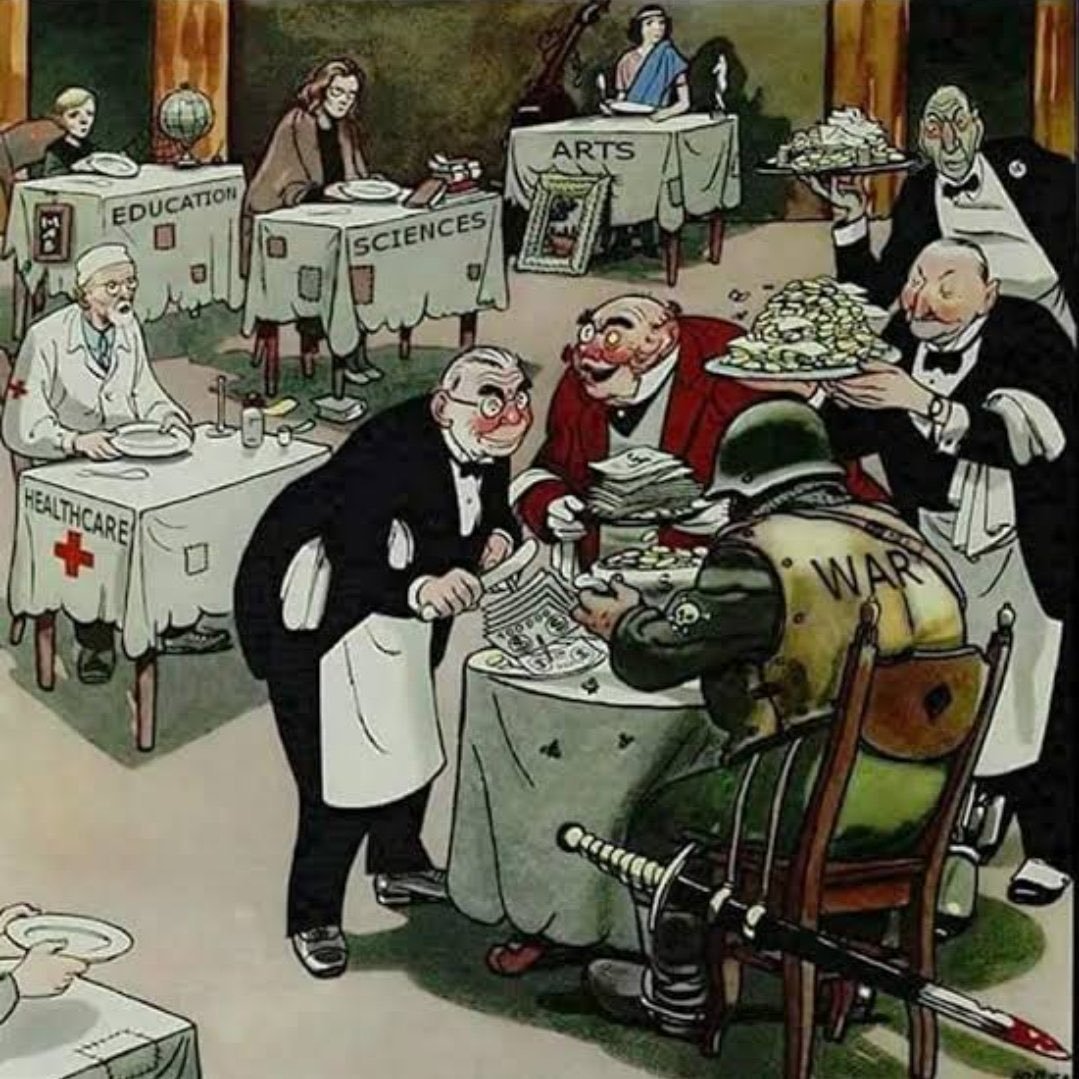
Wolff makes an interesting argument that rings true. Average Americans have almost zero influence on policies so any change will be driven by elite rivalry and competition. Other capitalist sectors will come to see the military/industrial/complex MIC as detrimental to their own future success in the zero-sum competition going forward.
But, there are things behind things. The MIC has a powerful lock on American policy due to the undue influence of the neoconservatives who permeate every aspect of the national security state, and who remain blinded by the myth of American exceptionalism and its attendant ills to such a degree that they are unable to discern things as they really are.
 camelotkidd