The submerged state


If the Democrats ever want to win another election they need to abandon neoliberalism.

Post-Watergate Democrats turned their backs on the central tenet of the New Deal–that government should help Americans. In the process, they quit representing unions and working-class Americans in order to rake in the corporate cash. Now, the Democrats have internalized the values of neoliberal governance–that all should be subsumed by the market.

The neoliberal method of governance is clearly visible with the implementation of Obama’s signature policy–the Affordable Care Act. Instead of using government to provide universal healthcare, Obama used government to force Americans into a healthcare insurance market. If Obama and the Democrats had embraced a simple robust government system, like Medicare-for-all, in which the government directly provided health care, the consequences of any attempt to shrink it or eliminate it would be obvious, and Americans would have a stronger investment in defending it. But instead, the ACA was designed to do something far more complicated: to provide affordable health insurance using a privatized healthcare market system that would maintain the role of private, profit-seeking corporations as insurance providers. Obama’s effort to preserve the primacy of health insurance companies made the ACA so insanely complex, and the government’s role so remote and indirect, that now when Trump tries to dismantle Obamacare, most people don’t know what’s going on – and they don’t care.

In the process of embracing a neoliberal version of governance, the Democrats have submerged the state. Cornell professor Suzanne Mettler describes the submerged state: “In recent decades, federal policymakers have increasingly shunned the outright disbursing of benefits to individuals and families and favored instead less visible and more indirect incentives and subsidies, from tax breaks to payments for services to private companies. These submerged policies, obscure the role of government and exaggerate that of the market. As a result, citizens are unaware not only of the benefits they receive, but of the massive advantages given to powerful interests, such as insurance companies and the financial industry. Neither do they realize that the policies of the submerged state shower their largest benefits on the most affluent Americans, exacerbating inequality.”

While Democrats were pledging fealty to the market god, guess who attacked two of the foundational elements of neoliberalism—free trade and financialization–on his way to a surprise presidential win?

Labor organizer, Les Leopold, has written an article taking neoliberal Democrats to task, and warning that if Democrats attack President Trump from a neoliberal position they could be playing right into his hands.

“Not only is Trump violating neoliberal theory, he also is clashing with the most basic way Wall Street cannibalizes us. Without the free movement of capital, assisted by trade deals, financial elites and their corporate partners would not be able to slash labor costs, destroy unions and siphon off wealth into their own pockets.

In particular, we should be extremely worried about how Trump is approaching the loss of manufacturing jobs. The neoliberal fog should not cause us to miss the obvious: presidents Obama and Clinton did absolutely nothing to stop the hemorrhaging of middle-class manufacturing jobs to low-wage countries. (U.S. manufacturing fell from 20.1 percent of all jobs in 1980 to only 8.8 percent by 2013.) Not only did Obama and Clinton fail to stop even one factory from moving away, but they truly believed that capital mobility and free trade were good for America and the world. In other words they had sipped plenty of the neoliberal Kool-Aid.

Meanwhile, Trump is all in. He is saying that jobs in the U.S. are more important than the long-run benefits of capital mobility and TPP/NAFTA agreements. If he keeps bashing corporations for moving jobs abroad and if he manages to ignite even a mini U.S. manufacturing jobs boom, Trump could be with us for eight long years.”

Do the Democrats even want to win elections, or are they content to be the other corporate party that doesn’t suck quite as bad?

In my opinion the Democrats aren’t going to quit their neoliberal ways. For examples of how they are doubling down on neoliberalism, see here, and here.

In order to effectively oppose Trump the left is going to have to kill the neoliberal wing of the DNC and pry their cold dead hands from the levers of power.

After that, we need to do what the Democrats of yore did–use government to improve Americans lives, by subsidizing education, health care, super trains, childcare, etc.

Update: To see the Democratic embrace of neoliberalism in real time, watch Nancy Pelosi, lecture this poor college student who had the temerity to ask if the Democrats would ever consider progressive economic policies.

Update 2: Glen Greenwald notices the sorry state of Democrat affairs.

“A failed, collapsed party cannot form an effective resistance. Trump did not become president and the Republicans do not dominate virtually all levels of government because there is some sort of massive surge in enthusiasm for right-wing extremism. Quite the contrary: This all happened because the Democrats are perceived — with good reason — to be out of touch, artificial, talking points-spouting automatons who serve Wall Street, Silicon Valley, and the agenda of endless war, led by millionaires and funded by oligarchs to do the least amount possible for ordinary, powerless citizens while still keeping their votes.”


Posted in neoliberals | Tagged , , , , , , , , , , , , , , , , | Leave a comment

The Pawl


The recent election and its aftermath have been instructive.

Americans who supported Bernie Sanders, were castigated as naive, political utopians who failed to understand that the only option was to support Hillary, lest the evil Orange-One prevail. And now that Trump has won, we’re rebuked for failing to compromise and ally with neoliberals, like Lawrence Summers, as a means to oppose the president. My favorite piece of advice has got to be–“you’re just part of a circular firing squad.”

I beg to differ.

I’m just trying to be realistic.

In my opinion, the DNC and party elders were perfectly willing to sabotage the Sanders campaign and run the most establishment candidate–Clinton–in a historically anti-establishment election, all to maintain control over the party machinery and precious corporate donor network.

According to the Iron Law of Institutions: the people who control institutions care first and foremost about their power within the institution rather than the power of the institution itself.

Sound familiar?

Now, Democratic activists loyal to Clinton are lashing out at Bernie-bros. Even worse, Hillary and her sycophants are still blaming Obama’s refusal to investigate Russian hacking for Clinton’s loss. In the process, they’re becoming the new “war party,” while aligning themselves with the neoconservatives who’ve been responsible for so much of the chaos and suffering in the world today. Perversely, the immigrants detained at the airports are from the same countries in the Middle-East destroyed by the wars and regime-changes ginned up by the neocons and their liberal-interventionists sidekicks.

If the Democrats can’t admit what a terrible idea it was to run Hillary Clinton as their candidate, forget about them ever coming to terms with what a particularly disastrous succession the last two presidencies were. If Bush took the most decisive turn towards a fascist America, Obama’s eight years normalized his predecessor’s most radical policies, only with better public relations. Rather than examining the policies carried out by their hero–Barak Obama–the led to this juncture, Democrats now depict Trump as the stand-alone devil-incarnate.

The differences between Trump, and Obama are almost entirely cosmetic. In fact, Trump appears to be a logical continuation of a historical trend.

The American political system, since at least 1968, has been operating like a ratchet, and both parties — Republicans and Democrats — play crucial, mutually reinforcing roles in its operation. The electoral ratchet permits movement only in the rightward direction. The Republican role is fairly clear; the Republicans apply the torque that rotates the thing rightward. The Democrats’ role is a little less obvious. The Democrats are the pawl. They don’t resist the rightward movement — they let it happen — but whenever the rightward force slackens momentarily, for whatever reason, the Democrats click into place and keep the machine from rotating back to the left.”

(Picture of a mechanical ratchet)

We saw this dynamic with Clinton following Reagan and Bush-1, and now, in hindsight, it’s quite apparent that Obama faithfully played his traditional role following Bush-2.

Ian Welsh makes the same comparison. “So Obama got in power, he bailed out the banks, he fucked over ordinary home-owners, he increased deportations and ramped up drone assassinations. He was far harsher on whistleblowers than Bush had been and he re-signed all the bad bills when the time came, like the Patriot Act and the AUMF, which had given Bush massive executive power and carte-blanche to spy, and assassinate, and go to war. 

Obama institutionalized Bush.”

This brings us to the most important task at hand.

Before we can effectively oppose Trump, there is the urgency of reforming the Democratic party.

Ian Welsh offers some tips for the resistance. “In order to stop the next Trump, not just this one, you must have control of a party to the point that they are forced to roll back the terrible laws and policies of the last 40 years–and not just roll them back, but start pushing the lever even further towards equality, away from oligarchy, and towards civil liberties and widespread prosperity.”

If the Resistance wants to really succeed, to really make the US a better place, it must learn the lesson of those who fought and failed before. If you succeed at getting rid of Trump without changing the trajectory of US economy, foreign policy, and disrespect for civil rights, you have done little more than kick the can down the road.”

I understand that you have to compromise in politics, but not with the people who helped destroy our country. Obscuring these facts, or allowing those responsible to posture as opponents of all this is not just misleading but counter-productive.

The Republican leaders are scared of their base. If we want to be effective then the Democratic leadership needs to be scared of us.


Posted in neoconservatives, neoliberals | Tagged , , , , , , , , , , , , , , , , , , , , , | Leave a comment

Behind the throne


Making sense of the Trump presidency will be challenging. It’s a new environment with all preconceived notions of the American political system vanishing.

Up is down and down is up.

For example, liberals, who traditionally viewed the CIA as a rogue, lawless institution, now point to CIA reports of Russian influence in the recent presidential election as perfectly credible. Meanwhile, Trump immediately signs an executive order canceling the TPP, Obama’s signature trade pact that was opposed by Bernie Sanders and the left. Adding to the intrigue, Republicans in congress are chary of Trump, much preferring Mike Pence, the more traditional Republican, Vice-President.

How is one supposed to make sense of this chaotic political dynamic?

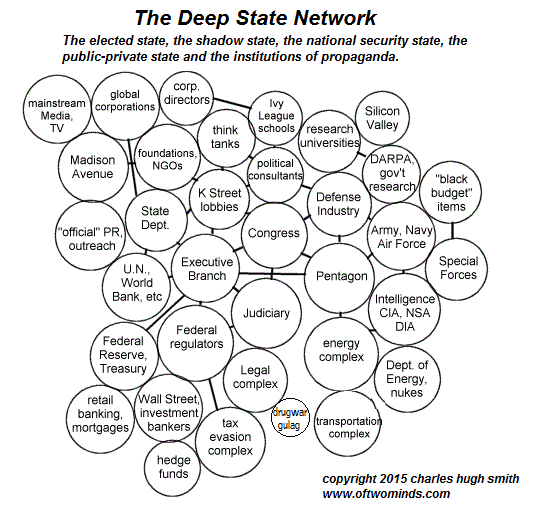
My method is simple–follow the deep state.

The knowledge of an American deep state has existed since C. Wright Mills wrote, The Power Elite, in 1956. Mills describes the deep state as a “triangle of power, linking the corporate, executive government, and military factions. …There is a political economy numerously linked with military order and decision. This triangle of power is now a structural fact, and it is the key to any understanding of the higher circles in America today.”

This theory has recently been updated with the publication of Mike Lofgren’s Deep State, which he describes as, “the unelected networks of elite private sector power (chiefly Wall Street, the military industrial complex, Silicon Valley, and their allies atop the national  government’s key state-capitalist and related repressive and imperial governmental institutions (including the National Security Council, the Joint Chiefs of Staff, the Department of Homeland Security, and the Federal Reserve) that rule the nation.”

The deep state power structure exists as a vast network of elite institutions. You might recognize one or two.

Examining the recent election in light of this power relationship we can see that Trump and Clinton represented different factions of the deep state. During the election the power elite became bitterly divided, with the majority supporting Hilary Clinton, the candidate pre-selected by the political and corporate factions, while the military faction rallied around their choice of Donald Trump.

The energy sector also seems poised to gain under the Trump administration with the nomination of Exxon’s CEO, Rex Tillerson, as Secretary of State. It appears that a major part of the Trump Administration foreign policy will be to normalize relations with Russia, while advancing oil industry interests. 

However, what Trump doesn’t seem to have grasped is that the deep state operatives of finance and intelligence will not likely permit him to enjoy functional power while he tries to seriously enact a “populist,” “protectionist,” and “isolationist” America-First agenda. After all, the deep state controls a worldwide capitalist empire and favors a globalist agenda where the American people are just one more pool of labor to exploit.

Trump’s mercurial speech, tweets and actions have set off alarms. What the deep state desires most of all is stability and continuity. This reality is what made Obama the ultimate deep state president, and Trump the ultimate loose-cannon. After the disaster of Bush, Obama’s great strength was that he was the perfect figurehead; a suave public relations president who represented our oligarchy with a façade of democratic and constitutional process. Now, to the deep state’s horror, Trump has ripped the facade away from the myth of American exceptionalism, where the United States is the world’s great beacon of democracy, human rights, justice, and freedom.

We are in dangerous times, with Trump yet to fully consolidate his power.

The deep state remains in conflict, with a serious crisis imminent. Indeed, there is strong evidence that the neoconservatives, and the national intelligence faction of the deep state have decided to wage a “color revolution” against President Trump.

2017 is shaping up to be our very own year of living dangerously.


Posted in neoconservatives, neoliberals | Tagged , , , , , , , , , , , , , , , , , , , , , | Leave a comment

The art of the possible


Politics is the art of the possible.

It’s not enough for Democrats to simply oppose the policies of Donald Trump, they need to offer alternatives. And, while the marches and protests organized by the DNC and supporting NGO’s are great, there needs to be a series of proposals articulating progressive economic and social policies.

Former Secretary of Labor, Robert Reich, wrote an essay recently where he made a similar point.

“Democrats have to fight like hell against the regressive policies Trump wants to put in place, but Democrats also need to fight for a bold vision of what the nation must achieve—like expanding Social Security, and financing the expansion by raising the cap on income subject to Social Security taxes; Medicare for all; and world-class free public education for all. And Democrats must diligently seek to establish countervailing power—stronger trade unions, community banks, more incentives for employee ownership and small businesses, and electoral reforms that get big money out of politics and expand the right to vote.”

In articulating a bold new vision we should acknowledge Modern Monetary Theory(MMT), where the US, as a sovereign issuer of its own currency, can afford to fund progressive policies, like infrastructure spending, without being constrained by taxes or deficits. For a much more detailed explanation of MMT, see this talk by Stephanie Kelton at New Economic Perspectives. (Warning! It will blow your mind.)

One of the most infuriating statements by President Obama was his insistence that the US was like a household and must tighten its belt during hard times. The opposite is true, and the statement belied his actions when it came time to bail out the banks. To test this hypothesis ask yourself a question. Where did the money, that Obama used to bail out Wall Street, come from?

To hide the fact that they have embraced capital and abandoned labor, the Democrats have substituted identity politics. Until the disastrous campaign of Hillary Clinton, this bait-and-switch has succeeded brilliantly. Millions of liberals have completely bought the story that “social justice” campaigns on behalf of marginalized social groups were the defining feature of liberalism and consequently, the Democratic Party.

The darkly humorous aspect of US politics is the inevitable blowback that accompanies devious schemes. According to writer John Michael Greer, identity politics perversely helped birth the alt-right movement.

“The Alt-Right scene that’s attracted so much belated attention from politicians and pundits over the last year is in large part a straightforward reaction to the identity politics of the left. Without too much inaccuracy, the Alt-Right can be seen as a network of young white men who’ve noticed that every other identity group in the country is being encouraged to band together to further its own interests at their expense, and responded by saying, “Okay, we can play that game too.”

In my opinion, the politics of identity are a dead end, allowing our bi-partisan political elite to divide and rule, while the masters of the universe laugh all the way to Davos.

Meanwhile, the reason that Bernie Sanders campaign elicited such an outpouring of support among young people is that he offered up concrete policies to make their lives better. Alternatively, the reason for the Democrats recent travails, is that they have, since Carter, abandoned labor and embraced neoliberalism, which is effectively capital. For an overview of this, see Thomas Frank’s, Listen Liberal.

Sanders failed political campaign offers a template for progressive economic policies that will improve Americans lives. Good policies make good politics. If Democrats want to regain power they will need to offer up authentic, universal policies instead of warmed over neoliberalism and identity politics.

Reich ends his essay on the Democrats shortcomings with a warning.

“The Party must change from being a giant fundraising machine to a movement. It needs to unite the poor, working class, and middle class, black and white—who haven’t had a raise in 30 years, and who feel angry, powerless, and disenfranchised. If the Party doesn’t understand these seven truths and fails to do what’s needed, a third party will emerge to fill the void. Third parties usually fail because they tend to draw votes away from the dominant party closest to them, ideologically. But if the Democratic Party creates a large enough void, a third party won’t draw away votes. It will pull people into politics. And drawing more people into politics is the only hope going forward.”

Let’s get busy.

Update: There is enormous opportunity for organization at the state and local level. Voter registration should be a key area of concern. Since Obama won his first term in 2008 the Democrats have lost 1,030 seats across the board. This includes seats in state’s houses and senates, governorships, and Congress.

Posted in neoliberals | Tagged , , , , , , , , , , , , , , , , , , , , , , | Leave a comment

Member the Maine?


Member?

I member a South Park episode entitled Member Berries, which are small purple berries that utter nostalgic, so-called historical phrases, where I thought I would pee myself laughing. The focus on American citizens shallow, superficial, Disneyfied version of history, was perfectly ripe for satire.

Member “fake news”?

I member that throughout much of our history the US corporate media has employed “fake news” to stampede Americans to war, justified in the name of patriotism and national security. I also member that we had a name for such perception management–propaganda.

Propaganda or “fake news” is quite useful for our ruling elite. After all, war is the health of the state.

Member the Maine?

I member that William Randolf Hearst ordered one of his photographers to, “Furnish the pictures and I’ll furnish the war,” as a way to galvanize American sentiment for the Spanish-American War.

Member the Committee on Public Information?

I member the Creel Committee, named for the head of the CPI, whipping up war hysteria against Germans, allowing President Woodrow Wilson to enter World War I on the side of the Allies, so that US bankers could have their loans repaid. The Creel Committee was able to turn America from being firmly pacifist to being eager to fight the evil Huns in 18 months.

Member the Gulf of Tonkin?

I member that the supposed attack on US destroyers by North Vietnamese gun boats was “fake news” designed to drive public support for the introduction of US ground troops into the quagmire of Vietnam.

Member the first Gulf War?

I member that on Oct. 10, 1990, a 15-year-old Kuwaiti girl identified only as “Nayirah” told the Congressional Human Rights Caucus that she witnessed Iraqi soldiers removing babies from incubators and tossing them on a cold floor to die. Her testimony was used by senators and even President George H.W. Bush as  justification for backing Kuwait in the Gulf War against Saddam Hussein, which erupted just three months later.

However, it was later revealed that “Nayirah” was the daughter of Kuwait’s ambassador to the United States, and her testimony was arranged by a PR firm representing a Kuwaiti-sponsored group lobbying Congress for military intervention.

Member yellowcake, aluminum tubes, and Curveball?

I member that in 2002, there was the mother of all, “fake news” stories–weapons of mass destruction–rolled out in September by George Bush’s chief of staff, Andrew Card, a former PR head who declared that: ”From a marketing point of view, you don’t introduce new products in August.” I also member that Judy Miller and the New York Times, did all they could to help sell this “fake news” story.

War is a product, to sell.

Member?

Right now, there is a coordinated media campaign afoot to escalate the new cold war against Russia. The election of Trump with his professed desire to reset relations with Putin threatens this endeavor. Hence the recent attacks in the form of anonymous stories about Russian influence in the presidential election, and Trump’s supposed sexual dalliances while in Moscow.

Member golden showers?

I member.

My take on the “fake news” phenomenon is it’s yet another phase to keep the American people, with their superficial knowledge of history, even more confused and misdirected. It is a strategy to double down on pro-war propaganda.

Our elite are in a panic now with the US empire crumbling and their economic system of neoliberalism failing. The failed foreign-policy and economic strategy of the neoconservatives and neoliberals has served to dramatically reduce Washington’s role and influence in the world. Even more importantly, they have lost control of the narrative, as more and more people question the official party line. The “fake news” panic is largely because the corporate media, spewing an endless stream of propaganda aimed at sustaining the political elite, have completely lost their battle to appear credible while reaching unprecedented peaks of immorality and hackery.

Member?


Posted in neoconservatives, neoliberals | Tagged , , , , , , , , , , , , , , , , , , , , , , , , , | Leave a comment

Ruling Ideologies


Since the end of the Cold War in 1989, the United States has been operating under the auspices of two mutually reinforcing ideologies–neoliberalism and neoconservatism.

By criticizing trade treaties like the TPP and NAFTA, while promising to mend relations with Russia and cease regime change, president-elect Trump is challenging the continuation of these ruling ideologies.

Historian, Andrew Bacevich, has written an essay that examines how the US squandered a historic opportunity with the fall of the Berlin Wall and the end of communism. In the process, Bacevich traces the US economic and foreign policies that have led to the election of Trump.

“Globalization, militarized hegemony, and a more expansive definition of freedom, guided by enlightened presidents in tune with the times, should have provided Americans with all the blessings that were rightly theirs as a consequence of having prevailed in the Cold War.  Instead, between 1989 and 2016, things kept happening that weren’t supposed to happen.”

Bacevich doesn’t quite say it, but the things that kept happening should be properly understood as the blowback from the twin ruling ideologies–neoliberalism and neoconservatism.

The US elite saw the end of the Cold War as a marvelous opportunity to expand and consolidate the empire they inherited from Great Britain at the end of WWII. Since the US is supposedly a “democratic republic” there needed to be a cover story. The idea of the US is a “reluctant imperialist” or a “benevolent empire,” has been ongoing within academic literature and US corporate media to both advocate for and justify the existence of American domination of the world.

Thanks to planning documents, we know that the US was not a reluctant or accidental empire, nor, for that matter, a benevolent one. America chose to be an empire; it was strategised, discussed, debated, planned and implemented. The key architects of this empire were the bankers and corporations which arose out of America’s Industrial Revolution in the late 19th century, the prominent think tanks created throughout the first half of the 20th century, and the major academics, economists and policy-makers who emerged from the universities, institutes, think tanks, and the business community, and who dominated the Washington D.C. planning circles that made policy.

These very same ruling sentiments reemerged at the end of the Cold War. However, with the demise of the Soviet Union, US planners has no need to soften or disguise their economic and foreign policies to appease critics at home or abroad. Now, to quote Margaret Thatcher, there was “no alternative.”

Under the auspices of neoliberalism, the US has pushed a program of globalization led by U.S.-based financial institutions and transnational corporations.  Supposedly, this “open world” would facilitate the movement of goods, capital, ideas, and people and thereby create wealth on an unprecedented scale. “In the process, the rules governing American-style corporate capitalism would come to prevail everywhere on the planet, while US corporations and banks dominated the worlds economic system.”

Under the auspices of neoconservatism, the US has carried out a militaristic foreign policy, overthrowing or invading states not to our liking. “Since the dissolution of the USSR in 1991, the U.S. has waged war (sometimes creating new client-states) in Bosnia (1994-5),  Serbia (1999), Afghanistan (2001- ), Iraq (2003- ), Libya (2011), and Syria (2014- ), while raining down drone strikes from Pakistan to Yemen to North Africa. These wars-based-on-lies have produced hundreds of thousands of civilian deaths, millions of refugees, and general ongoing catastrophe throughout the Middle East.”

Thus, to maintain US corporate hegemony, neoliberalism is dependent upon neoconservatism. This dynamic was well summed up by NY Times columnist Thomas Friedman, in his book the Lexus and the Olive Tree“The hidden hand of the market will never work without a hidden fist. McDonald’s cannot flourish without McDonnell Douglas, the designer of the U.S. Air Force F-15. And the hidden fist that keeps the world safe for Silicon Valley’s technologies to flourish is called the U.S. Army, Air Force, Navy and Marine Corps. For globalism to work, America can’t be afraid to act like the almighty superpower that it is.”

The problem with the neoliberal, neoconservative, corporate empire is that the gains have largely accrued to the 1%, with the vast majority of Americans coming out the worse for these policies. The election of Trump reflects this discontent. His supporters may not understand the details of the neoliberal and neoconservative policies of empire but they sense the vast betrayal carried out by our bi-partisan elite.

The series of crises that culminated with the election of Trump have been caused by our elite’s embrace of neoliberalism and neoconservatism.

Trump’s presidency will succeed or fail based on whether or not he can break free of these ruling ideologies.

Update: It used to be that the Republicans were the party that favored endless war but lately the Democrats have gotten into the act. After Hillary lost the presidential election the Democrats wasted no time in blaming her loss on the hacking of the nefarious Russians. Of course, since war is a bi-partisan affair, the Democrats were joined in their denunciation of Russia by neoconservatives, liberal interventionists, the corporate media, various Soros-funded NGO’s, virtually all the important think-tanks, and the CIA and the other intelligence agencies.

In my opinion, this hostility is designed to prevent Trump from seeking detente with Russia, and ensuring that the ruling ideology of neoconservatism remains intact. Likewise, there will be tremendous pressure on Trump to maintain the corporate globalization agenda favored by neoliberals.


Posted in neoconservatives, neoliberals | Tagged , , , , , , , , , , , , , , , , , , , , , , , , , , , | Leave a comment

Necessary Lessons


Liberals lamenting the election of Donald Trump have not absorbed the necessary lessons.

Rather than examining the policies of financial neoliberalism and the identity politics that provided neoliberalism its moral veneer, they are still blaming the Russians, or the racism and stupidity of the “deplorables”, for the loss of Hillary Clinton.

The voters who elected Trump, like the ones who voted for Brexit, did so as a revolt against neoliberalism, which has been responsible for the erosion of their living standard for the last 40 years. However, the vote for Trump was not just a rejection of neoliberalism, but a repudiation of “progressive neoliberalism“. Progressive neoliberalism married financial capitalism, as represented by Wall Street, with progressive social movements such as gay-rights, feminism, anti-racism, and multiculturalism. This is the platform that Democratic candidate Hillary Clinton ran on.

Trump was treated as a joke, and Democrats like Hillary saw him as the ideal candidate to run against. Up until the final election results, liberal media icons, like the New York Times and Washington Post, predicted victory for Hillary.

The DNC and elite liberal media believed their own propaganda–that the new, hip, urban, progressive coalition had consigned the old, reactionary, rural, conservative coalition to the dustbin of history.

Surprise.

And now, in the US and Britain, there is a great deal of anger at those impertinent citizens who voted the wrong way. They are castigated as evil or racist, or maybe too dumb to vote for their own self-interests. In just one example, liberal writer, Daily Kos publisher and Vox Media co-founder Markos Moulitsas proclaimed: “Be Happy for Coal Miners Losing Their Health Insurance. They’re Getting Exactly What They Voted For”

This sort of shit is nauseating. If we are succeed in opposing the kleptocratic ruling policies of Trump, we need to be honest in examining the reasons for his election and not engage in attacks against prospective allies. The owner-class is certainly celebrating this infighting. Divide and conquer is as old as the hills, and predictably effective.

In my opinion, what has made the election of Donald Trump possible is the absence of a workers party in the US. This has led to the lack of a vision that could link the legitimate economic grievances of Trump supporters with an trenchant critique of neoliberalism, together with policies of equality for people of color, woman, and LGBT.

The Democratic Party, as represented by candidate Hillary Clinton, has  no interest in such policies, as demonstrated by their repeated failure to unite labor with these new social movements. Perhaps it wasn’t a bug but a feature to disguise who their true masters on Wall Street are. After all, the Democrats got to pose as liberals, while secretly promoting policies that have impoverished the majority of Americans, while enriching the ownership class.

The necessary lesson to draw from all of this is that the Democratic Party, as it is presently configured, is not a real opposition party.

Now, what are we going to do about it?


Posted in neoliberals | Tagged , , , , , , , , , , , , , , , | Leave a comment

War Pigs: or How Liberals Learned to Stop Worrying and to Love the Drone


When did the liberals turn into war pigs?

If there was going to be anything positive from the election of Trump, it was the lowering of tensions between the US and Russia.

With liberals excitedly pointing to the CIA’s assessment that Russia hacked our election, that may not happen.

In fact, I believe that this demonization is an attempt to block President–elect Trump from advancing better relations with Russia.

I’m old enough to remember when liberals distrusted the CIA and saw them as the enemy. 

For good reason. Since its inception in 1947, the CIA has employed a network of willing media conduits to propagandize the American people as part of Operation Mockingbird.

Fake news, indeed.

There’s also that little matter of projection. “The U.S. has a long history of attempting to influence presidential elections in other countries – it’s done so as many as 81 times between 1946 and 2000, according to a database amassed by political scientist Dov Levin of Carnegie Mellon University. That number doesn’t include military coups and regime change efforts following the election of candidates the U.S. didn’t like, notably those in Iran, Guatemala and Chile.”

I believe the real reason for all of this is that the military/industrial/complex is desperate for an ongoing conflict with Russia as a way to maintain their funding. There is just too much money and power at stake for the complex to shrink.

The biggest threat to the MIC has always been the threat of peace. With the fall of the Soviet Union in 1991, much of the military-industrial complex was suddenly deprived of its reason for existence—the threat was gone. Since then there has been a frantic search for new enemies to justify its enormous spending, and boondoggles like the F-35.

Now, Trump is threatening their feeding trough.

Why do you need a billion dollar fighter plane to battle stateless terrorists holed up in a cave?

You don’t.

The evil Russian empire, led by bad-Vlad?

Now you’re talking.

A Russian enemy requires all kinds of high-tech (read expensive) weapon systems, like the F-35. Maybe some more nukes.

What’s truly upsetting is that this love of war by liberals was brought on by Mr. “Hope and Change”. Since 2009, Obama, and his merry band of liberal/interventionists, like Samantha Power, Susan Rice, and Victoria Nuland, have been doing a pretty good neoconservative imitation.

In a manner, Obama has institutionalized many of the horrible foreign policies of Bush, with better public relations. Instead of capturing so-called terrorists and torturing and imprisoning them like Bush did, Obama simply assassinates them via drone.

Ironically, Obama was awarded the Noble peace prize, before the committee even had any idea about his future policies.

What, you were expecting bankers in orange jumpsuits?

It’s all tribal. When Bush was doing these horrible things, liberals were in high dungeon, but when Obama is doing the same, or worse, they defend it.

I’m sure that when Trump begins the next war, liberals will be back to denouncing violence.

There was a song in my youth that spoke of such things.

“Now in darkness, world stops turning,
ashes where the bodies burning.
No more war pigs have the power,
hand of god has struck the hour.
Day of judgement, god is calling,
on their knees the war pigs crawling.
Begging mercy for their sins,
Satan, laughing, spreads his wings…Oh lord, yeah!”

Posted in neoconservatives | Tagged , , , , , , , , , , , , , , , , , , , , | Leave a comment

Planned economy


The election of Donald Trump has caused an outpouring of grief and many commentators are convinced that the end of the world is nigh. However, Trump didn’t get us to this place, he was just a savvy opportunist who took full advantage of the economic and foreign policies that both Democrats and Republicans have pursued for the last 40 years.

Supposedly, the US eschews governmental planning in favor of a so-called free market. Of course, every economy is a planned economy, it just depends on who does the planning.

Economist, Michael Hudson, says that Wall Street plans the US economy.

“Under Greenspan and modern economics, a market is “free” from government regulation, free from throwing the bankers in jail when they commit crime, free from any kind of policymaking by government, by labor unions, or by society. So a free market today is a centrally planned economy, but it’s not planned by government. The planning is shifted out of government to the banks.”

Hudson says that US economists, especially the ones that work for the Federal reserve, justify the planning of the economy by Wall Street.

“They’re drawn from these Wall Street institutions. It’s also the financial sector that endows the universities and the business schools. Hardly by surprise, these schools teach that there is no such thing as unearned income, no exploitation. They teach that the financial sector is the most productive sector in the economy, instead of a burden that should be subtracted from GDP, because it’s an overhead that the rest of the economy has to pay.”

What Wall Street wants is the financialization of the US economy. This has resulted in the offshoring of American manufacturing and concomitant loss of jobs by former middle-class workers. The CEO’s of manufacturing corporations can make more money by strip-mining their business, aided and abetted by hedge funds who want to extract as much wealth as possible from the company while putting back as little as possible into production and workers.

Wall Street friendly economists justified this through their policy of shareholder value. Until the late 1970s changes in real wages tracked changes in productivity in the U.S. economy. It was the retain-and-reinvest employment policies of major U.S. corporations that largely accounted for this shared prosperity. Thanks to the theory of shareholder value, pushed by Wall Street friendly economists, “since the late 1970s there has been a widening gap between the growth in productivity and the growth in real wages, caused by a downsize- and-distribute regime in which corporate executives look for opportunities to downsize the labor force and distribute earnings to financial interests.”

In his voluminous writings, Hudson makes the distinction between earned and un-earned income. He points to classical economics, practiced by John Stuart Mills, and Adam Smith, which sought to free up an economy from rent, or financial overhead, so that small businesses could thrive.

The problem is that both Republicans and Democrats favor the powerful financial interests that fund them. They have no interest in creating an economy like the one Hudson describes. Both parties repeat Margaret Thatcher’s maxim–there is no alternative. The Democrats are particularly offensive since they pose as the party of labor. During the recent presidential campaign, Hillary insisted that no change was possible from that of financial neoliberalism— which Adolph Reed has succinctly defined as “capitalism without a labor opposition”.

But the American people know better. Our corporate media cheerleaders have suppressed the fact that economic policies that are considered far to the left by our political elite enjoy popular support among the American people.

For instance, clear majorities of Americans favor breaking up the too big to fail banks, single payer health-care system, free college tuition, and many other “socialist” policies, like the ones put forth by Bernie Sanders during his campaign for president. Sander’s campaign articulated a broad social-democratic program on inequality, regulating Wall Street, health care, education, housing, and jobs and expanded the political discourse to include the categories of class, power, and democratic socialism. It even demonstrated that money was not a definitive barrier to an electoral challenge.

Unfortunately, we’re stuck with Trump, thanks to the DNC, with their single-minded quest to elect Hillary Clinton at all costs, even sabotaging Sanders campaign, as the WikiLeaks files demonstrate.

But, Trump has inherited a mess, with a country hopelessly divided. And, with much of the deep state arrayed against him, he faces opposition to his presidency. If he makes it to the White House he will face an immediate challenge from Federal-Reserve Chair Janet Yellen who recently raised the interest rate, potentially derailing Trump’s economic agenda.

If Trump wants to govern he will absolutely require the ability to plan the US economy, with or despite Wall Street and the other members of the deep state.

Grab some popcorn.

Update: Ian Welsh makes the obvious point–Kleptocracy is neoliberalism’s child, its logical end-result, and Trump is just a new stage in kleptocracy.


Posted in neoconservatives, neoliberals | Tagged , , , , , , , , , , , , , , , , , , | Leave a comment

Internal divisions


The election of Donald Trump is provoking internal divisions within the deep state, leading to some very interesting disclosures. Indeed, there is a battle being waged for influence and control in the presumptive Trump administration.

It might be useful to reexamine Mike Lofgren’s essay describing the deep state, to help suss out how and why this battle is being prosecuted. Lofgren was a congressional staff member for 28 years specializing in national security and possessing a top secret security clearance.

“There is another government concealed behind the one that is visible at either end of Pennsylvania Avenue, a hybrid entity of public and private institutions ruling the country according to consistent patterns in season and out, connected to, but only intermittently controlled by, the visible state whose leaders we choose.

The deep state is the big story of our time. It is the red thread that runs through the war on terrorism, the financialization and deindustrialization of the American economy, the rise of a plutocratic social structure and political dysfunction. 

The deep state does not consist of the entire government. It is a hybrid of national security and law enforcement agencies: the Department of Defense, the Department of State, the Department of Homeland Security, the Central Intelligence Agency and the Justice Department.” 

Lofgren says that members of the deep state, while pretending to be neutral technocrats with America’s best interests at heart, “almost invariably believe in the “Washington Consensus”: financialization, outsourcing, privatization, deregulation and the commodifying of labor. Internationally, they espouse 21st-century “American Exceptionalism”: the right and duty of the United States to meddle in every region of the world with coercive diplomacy and boots on the ground.”

So far Trump has resisted the daily presidential briefing by the CIA in favor of briefings by his nominee to be national security adviser, former Defense Intelligence Agency head General Michael Flynn.

Now, there’s the new CIA report alleging Russian meddling in the US election to favor Trump rather than Clinton. This report should be understood as a direct attack on the new administration by the CIA, who favored Hillary for president.

If you will recall, the CIA is strongly committed to regime change in Syria as part of its foreign policy mandate. Also, the CIA director, John Brennan, is very close to US ally Saudi Arabia, having served as the CIA station chief there before being named Obama’s national security advisor, and, then head of the CIA. Saudi Arabia is also committed to regime change in Syria, providing clandestine support with the U.S., Qatar and other Gulf States.

The dirty little secret of the war on terror is that for all the rhetoric about fighting terrorists the US is happy to use them to advance policy goals. To that end, the CIA has been funneling weapons and money through Saudi Arabia, Turkey, Qatar and others who provide direct and indirect support to groups like ISIS and al-Qaeda. This support has allowed al-Qaeda and their fellow terrorist organizations to establish strongholds throughout Syria, including in Aleppo.

The goal of such support for the Sunni terrorists attacking Syria is the creation of a Salafist principality” in east-Syria and west-Iraq. Gulf countries’ and Israeli lobbyists have called for such an occupation strategy. A U.S./Saudi controlled proxy entity that interrupts the “Shia crescent” from Iran over Iraq and Syria to Lebanon and holds the ground for a planned natural gas pipeline from Qatar to Turkey and onto Europe.

Meanwhile, Syria is supported by Russia. And, Trump has promised to mend relations with Russia. The Russian and Syrian hope may be that a Trump administration will abandon the present regime change policy.

Intelligence, and foreign policy expert, Marcy Wheeler, helps unpack all of this, and what it portends for the deep state going forward.

“First, if Trump comes into office on the current trajectory, the US will let Russia help Bashar al-Assad stay in power, thwarting a 4-year effort on the part of the Saudis to remove him from power. It will also restructure the hierarchy of horrible human rights abusing allies the US has, with the Saudis losing out to other human rights abusers, potentially up to and including that other petrostate, Russia. It will also install a ton of people with ties to the US oil industry in the cabinet, meaning the US will effectively subsidize oil production in this country, which will have the perhaps inadvertent result of ensuring the US remains oil-independent even though the market can’t justify fracking right now.

The CIA is institutionally quite close with the Saudis right now, and has been in charge of their covert war against Assad.

This story came 24 days after the White House released an anonymous statement asserting, among other things, “the Federal government did not observe any increased level of malicious cyber activity aimed at disrupting our electoral process on election day,” suggesting that the Russians may have been deterred.”

So, what is the purpose of such a leak, as Trump prepares to take office?

Here’s Marcy again. “The propaganda effect of these leaks will be to dampen any movement of a Trump administration towards more friendly relations with Russia. Any such move by Trump will be responded with a chorus “but Russia hacked our election” even though there has been zero evidence or proof produced that such was indeed the case.”

The plot thickens.

Posted in neoconservatives, neoliberals | Tagged , , , , , , , , , , , , , , , , , , , , , , , , , , , , , , | Leave a comment