The Stovepipe

The United States tortured prisoners for exploitation and propaganda purposes with the goal to connect al-Qa’ida with Saddam. We used this false information, obtained through torture, to justify the invasion of Iraq.

“…the details in the Senate report concerning the abuse of often totally innocent people are less damning than the evidence that a key reason for the torture was to produce “intelligence” that could be used to build the case for war on Iraq. That splendid little war that Bush, Cheney, Rumsfeld, Wolfowitz and the neocon cabal within the Defense and State Departments, and the all-powerful Office of the Vice President, so deeply craved. That war that destroyed Iraq, killed half a million people, spurred sectarianism, forced millions to flee, generated ongoing civil war and produced the child-beheading ISIL.”

Back in the mists of time this seemed to be understood. In the aftermath of the invasion of Iraq, when it was apparent there was no weapons of mass destruction and no connections between Saddam and al-Qa’ida, there were strong suspicions about the manufactured intelligence for war and how it was acquired. Recall the Office of Special Plans (OSP)–the secret intelligence office in the Pentagon whose very existence was predicated on making the connection of al-Qa’ida to Saddam, by stove piping intelligence. Stove piping occurs when raw intelligence that hasn’t been vested by professional intelligence analysts gets passed up the chain of command. The neocon zealots in the OSP went over to the dark side and had captives tortured until they linked Saddam to al-Qa’ida.

The intrepid Marcy Wheeler, at Emptywheel, examines the Senate Armed Services Committee Report on torture, which was released 5 years ago, and finds this interesting segment that makes this clear.

“The torture of Ibn Sheikh al-Libi, whose torture-induced claim al Qaeda had ties to Iraq’s WMD programs helped drag us into Iraq,

According to al-Libi, the foreign government service [redacted] “stated that the next topic was al-Qa’ida’s connections with Iraq. … This was a subject about which he said he knew nothing and had difficulty even coming up with a story.” Al-Libi indicated that his interrogators did not like his responses and then “placed him in a small box approximately 50cm x 50cm.” He claimed he was held in the box for approximately 17 hours. When he was let out of the box, alLibi claims that he was given a last opportunity to “tell the truth.” When al-Libi did not satisfy the interrogator, al-Libi claimed that “he was knocked over with an arm thrust across his chest and he fell on his back.” Al-Libi told CIA debriefers that he then “was punched for 15 minutes.”216

(U) Al-Libi told debriefers that “after the beating,” he was again asked about the connection with Iraq and this time he came up with a story that three al-Qa’ida members went to Iraq to learn about nuclear weapons. Al-Libi said that he used the names of real individuals associated with al-Qa’ida so that he could remember the details of his fabricated story and make it more believable to the foreign intelligence service. Al-Libi noted that “this pleased his [foreign] interrogators, who directed that al-Libi be taken back to a big room, vice the 50 square centimeter box and given food.”217

Over the weekend we had the architect of torture himself–Dick Cheney–on Meet the Press, defending torture. Of course, the Toddler didn’t broach the possibility of torture for false confessions to justify the war Cheney and the neocons wanted all along. That would be rude.

This reality that “we tortured some folks” to justify the invasion of Iraq is too horrible for the MSM to contemplate. The idea that our leaders are monsters is beyond the pale. It is the truth that dare not be spoken of.

And, anyway, Americans are cool with torture.

“Before Bush, most Americans were against torture.  The endless drumbeat of propaganda and the need to justify what America does (America is good, therefore America does not do evil), has had its effect.”


Posted in Uncategorized | Tagged , , , , , , , | Leave a comment

Apple Pie

No thoughtful observer of American history can be surprised at the Senate report detailing the torture carried out by the CIA in the aftermath of 9/11. The revelation of torture should be seen as the logical outcome of economic and foreign policies carried out since the US became an empire. The 9/11 attacks only turbo-charged these policies. Since then we’ve suffered the anthrax attacks, the passage of the Patriot Act, the invasion of Iraq,  revelations of NSA spying, the massive Wall Street crime spree that threw millions of Americans out of their homes and jobs, and the appearance of a financial and political elite that is demonstrably above the law, protected by a police force that can murder with impunity. We are, as Chris Floyd says.

“Living in an age given over to state terror and elite rapine.”

Neoliberal and neoconservative ideologies have been the focus here lately in an attempt to grapple intellectually with this savage milieu. Neoliberal ideology is the force behind the economic policies that have wrecked such havoc and brought about the rampant inequalities that have become impossible to ignore. Neoconservative ideology promotes the use of force to enforce these neoliberal economic policies. Neoconservatives think-tanks proclaim that the US should control the whole world using full spectrum dominance, with the whole thing propagandized as American exceptionalism.

I’ve come to believe that neoliberalism and neoconservatism have merged into neofeudalism–a sort of all-American free market authoritarianism, where torture is just one of the many instruments of statecraft. Recently, we were privileged to see the pure essence of this neofeudal, free market authoritarianism, with former Bush campaign spokeswoman, Nicolle Wallace on TV shrieking–“I don’t care what we did.”

Examining past empires provides strong evidence that crimes and horrors perpetrated by an empire on the periphery always find their way back to the homeland. And lo-and-behold, it turns out that the US empire has been committing lots of crimes on the periphery, with torture the most shocking and egregious example.

US neoliberal economic policies came out of the University of Chicago, under the tutelage of Milton Friedman. These policies were first implemented in Chile in 1973 after the violent coup carried out by General Pinochet, with help from the CIA. Friedman and his “Chicago Boys” advised Pinochet to impose his free market wish list on the country–tax cuts, free trade, privatized services, deregulation and cuts to social spending. As Naomi Klein makes clear in The Shock Doctrine, although Chile was described in glowing term as an economic miracle, the reality was that these economic policies were imposed by force, including torture.

“Pinochet also facilitated the adjustment with his own shock treatments; these were performed in the regimes many torture cells, inflicted on the writhing bodies of those most likely to stand in the way of the capitalist transformation. Many in Latin America saw a direct connection between the the economic shocks that impoverished millions and the epidemic of torture that punished hundreds of thousands of people who believed in a different kind of society. As Uruguayan writer Eduardo Galeano asked, ‘How can this inequality be maintained if not through jolts of electric shock?'” 

Every policy carried out by an empire on the periphery returns to the homeland. Today, Americans are treated as disposable with value conferred only if you succeed in transforming yourself into a marketable entity. Americans have become less citizens than consumers, with only consumers having a semblance of rights.(If you manage to read the fine print.) The neoliberal economic policies of the last 40 years have created a vast class of the superfluous people who are controlled by a occupying force of police, as we have recently witnessed in Ferguson.

“Neoliberal policies aim to reduce wages to the bare minimum and to maximize the returns to capital and management. They also aim to de-mobilise workers’ organisations and reduce workers to carriers of labour power — a commodity to be bought and sold on the market for its lowest price. Neoliberalism is about re-shaping society so that there is no input by workers’ organisations into democratic or economic decision-making.”

Neoliberal policies are doing exactly what they’re supposed to be doing. This rampant inequality visible in the US today is not a bug, but a feature. Neoliberal policies are designed to rip apart civil society and leave individuals at the mercy of corporations and their wealthy owners.

“Human lives are only of interest in their transactional form. Just being alive is meaningless unless you are doing something with money or property. Just walking down the street enjoying the day is nothing. What matters is what you buy. What matters is who you do business with. What matters is working at some job, preferably for next to nothing. What matters is your investments, in financial capital, in human capital, in social capital, and how you manage those investments.”

Neoconservative full-spectrum dominance is the muscle backing up the US neoliberal economic order. New York Times columnist, Thomas Friedman, in a moment of candor, gives the game away.

“The hidden hand of the market will never work without a hidden fist. McDonald’s cannot flourish without McDonnell Douglas, the designer of the F-15. And the hidden fist that keeps the world safe for Silicon Valley’s technologies to flourish is called the US Army, Air Force, Navy and Marine Corps.”

In Iraq and Afghanistan, as well as other outposts of the empire, our military and intelligence agencies force compliance with American neoliberal economic policies, or punish non-compliance. Marine General Smedley Butler recognized this essential reality of what the US military did way back in 1935 when he wrote, War is a Racket:

“I spent 33 years and four months in active military service and during that period I spent most of my time as a high class muscle man for Big Business, for Wall Street and the bankers. In short, I was a racketeer, a gangster for capitalism.”

Here at home not only do we have a militarized police force, witnessed in Ferguson, but our legal system is basically an enforcement mechanism to ensure compliance with neoliberal economic policies, as Ian Welsh makes abundantly clear.

The legal system exists, today, to ensure compliance.

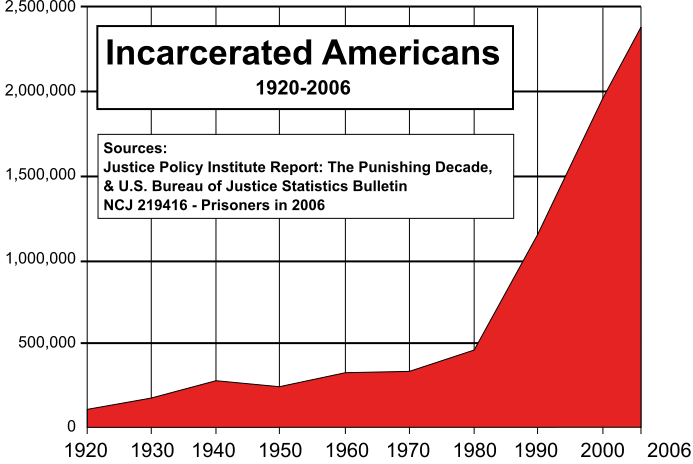
Graph of incarceration in the US over time

American oligarchical society rests on people not effectively resisting.  All gains now go to the top 10%, with the rest of society losing ground.  Incarceration rates blossom in 1980, which is also the year that the oligarchical program is voted in and becomes official.  (Trickle down economics can be understood no other way.)

And the legal system is not just for the poor and downtrodden. If you are a college educated well meaning liberal who has never even had a parking ticket but are opposed to these horrible policies, it doesn’t matter. Welsh describes what happens when you persist.

“Ordinary citizens must understand that they cannot change the system if elites do not agree with the changes they want made.  If they try, they will be arrested and receive a criminal sentence, meaning they can never again have a good job.”

Henry Giroux, Professor of English and Cultural Studies at McMaster University, points out that the US has long practiced torture, using plausible deniability. What was different after 9/11 was that the US openly embraced torture. He too connects torture to our economic system.

“Maybe it is time to treat the Senate torture report as just one register of a series of crimes being committed under the regime of a savage neoliberalism. After all, an economic policy that views ethics as a liability, disdains the public good, and enshrines self-interest as the highest of virtues provides a petri dish not just for state sanctioned torture abroad but also for a range of lawless and cruel policies at home.”

Giroux makes the obvious point from his reading of the Senate report: 

“Torture is as American as apple pie.”

So be a good neo-serf: Keep your nose to the grindstone and don’t complain.

Or else.

Update: If you want to understand just how lawless America has become, contemplate this: “No one except John Kiriakou is being held accountable for America’s torture policy. And John Kiriakou didn’t torture anyone, he just blew the whistle on it.” 

Posted in Uncategorized | Tagged , , , , , , , , , , , , , | 1 Comment

A Milo Minderbinder Moment

Neoconservatives have a lock on American foreign policy with an intellectual conformity among analysts, commentators and government policy makers that is breathtaking. This has happened, I believe, because neoconservatism represents the strong state necessary for neoliberal economic policies to be implemented nationally and globally. Neoconservatism also appeals to “American exceptionalism,” where in the post 9/11 milieu no politician wants to appear unpatriotic.

“…underneath all the maneuvering, the War Party thrives.  You simply can’t operate in Washington without in some fashion declaring your fealty to wartime thinking and the sanctified post-9/11 dead air that goes with it.  No alternative possibilities, no other options are on that “table” on which “all options” are always said to sit in the nation’s capital.  Should you not toe the line, the national security equivalent of excommunication is in order.” 

Again, that part about neoliberal economic policies requiring a strong state is salient. The US, as the dominant hegemon, uses force to implement its neoliberal economic policies.

“The problems between Ukraine and Russia over Crimea and federalism within Ukraine are a mask designed to cover Obama’s true intentions, which are the smashing of the BRICS as a viable alternative to the neo-colonialist financial systems of the West and subsuming the economies of the BRICS to the whims of the United States and the ever-teetering European Union.”

However, neoconservatives, because of greedy/ideology seem incapable of pursuing a foreign policy that is either wise, coherent, strategic, or cost-effective. To the uninitiated, American foreign policy appears to be a hash.

“Despite ongoing wars and operations in Afghanistan, Iraq, Syria, Yemen, and Somalia, among other places, the results of that experiment are in.  No single war, intervention, or minor conflict in which the U.S. military has taken part in these years has even come close to achieving the objectives set out by Washington and most have proven outright disasters.  In just about every case, armed intervention, whatever form it took, demonstrably made matters worse, increased the destabilization of whatever country or region was involved, and led to the creation of more extremists and terrorists.”

Much like neoliberalism, neoconservatism ideology succors the wealthy and powerful in the US, allowing a small intellectual faction outsized influence, and ensures that neoconservative policies will continue, no matter the outcome. Neocon’s are interesting characters, to say the least.

“The core group consists of neoconservative defense intellectuals. (They are called “neoconservatives” because many of them started off as anti-Stalinist leftists or liberals before moving to the far right.) They are products of the influential Jewish-American sector of the Trotskyist movement of the 1930s and 1940s, which morphed into anti-communist liberalism between the 1950s and 1970s and finally into a kind of militaristic and imperial right with no precedents in American culture or political history. The corners of the neoconservative pentagon were linked together in the 1990s by the Project for the New American Century (PNAC), run by Kristol out of the Weekly Standard offices. Using a P.R. technique pioneered by their Trotskyist predecessors, the neocons published a series of public letters whose signatories often included Wolfowitz and other future members of the Bush foreign policy team. They called for the U.S. to invade and occupy Iraq and to support Israel’s campaigns against the Palestinians.”

Neoconservative ideology is one of the chief culprits for the hyper-belligerent US foreign policy since the fall of communism. Neoconservatives have come to articulate, in the post Cold War era, a moral case for worldwide intervention in the name of free market capitalism. The invasion of Iraq was the tragic result of this murderous ideology. In The Shock Doctrine, Naomi Klein, vividly depicts neoconservatives using Iraq as their test subject for “disaster capitalism.”

“The Iraq invasion marked the ferocious return to the early techniques of the free-market crusade–the use of ultimate shock to forcible wipe out and erase all obstacles to the construction of model corporatist states free from all interference.”

Because neoconservatism has many factions and because this is America, it’s hard to tell where ideology ends and greed begins. The invasion of Iraq was the example of this overlap. Was it ideology, or greed? Hard to tell, maybe a bit of both. It sure helped your case as an investor in post invasion Iraq if you were also a true believer. Remember New Bridge Strategies, started by Joe Allbaugh, Bush’s head of FEMA, that promised to use its political connections to get American corporations a piece of the action in rebuilding Iraq after the US invasion? What about the poster-child for military privatization gone bad–Halliburton–overcharging taxpayers, while electrocuting US servicemen? Or, Blackwater, the mercenary army hired by the State Department to provide security, murdering Iraqis in Nisour Square? Oh, and don’t forget about the 20 billion dollars sent to Iraq in the early days of the occupation that vanished.

“The cash was literally delivered shrink-wrapped, on pallets, enormous bundles of Benjamins. So where did all that money go? Here and there on the web you can find a conspiracy theory or two, but the obvious answer is usually the correct one. There are no doubt Dubai-based bank accounts of current and former Iraqi government officials swollen with cash, perhaps some accounts of American contractors and various U.S. officials as well.”

There are still enormous amounts of money to be made from the neoconservative project to spread their free-market gospel. Take the war on terror. The more we fight terrorists, the more terrorist we create, and the more money the war on terror participants make. It’s a powerful feedback loop–a self licking ice cream cone. For the military-industrial-complex it’s a beautiful thing.

“But that by now seems to be not a bug but a feature. The “fear business” James Risen talks about is now driving billions of U.S. taxpayer dollars per year into a few private hands. Another 9/11 like event every few years will keep that business going. Letting al-Nusra get experience with U.S. tactics and weapons can only help to further that.”

Recent events are almost surreal in their similarity to fiction and replete with dark humor. In Syria, not only is the US arming and training extremist Sunni fighters, but they are simultaneously bombing them.

“With the documented conspiracy of the US and its allies to create a sectarian mercenary force aligned to Al Qaeda, the so-called “moderate rebels” the US has openly backed in Syria now fully revealed as sectarian extremists, and now with DW documenting a torrent of supplies originating in Turkey, it is clear that the ISIS menace NATO poses as the solution to, was in fact NATO all along. What is  revealed is a foreign policy so staggeringly insidious, few are able to believe it, even with international broadcasters like DW showing ISIS’ supply lines leading from NATO territory itself.”

It’s a Milo Minderbinder moment. First Lieutenant Milo Minderbinder was a fictional character in Joseph Heller‘s Catch-22. As the mess officer, Minderbinder was a war profiteer during World War II. Eventually, Minderbinder begins contracting missions for the Germans, fighting on both sides. At one point Minderbinder orders his fleet of aircraft to attack the American base where he lives, killing many American officers and enlisted men.

“In a democracy, the government is the people,” Milo explained. “We’re people, aren’t we? So we might just as well keep the money and eliminate the middleman. Frankly, I’d like to see the government get out of war altogether and leave the whole field to private industry.”

In the US, we are well on our way to Milo’s dream. To a large part we’ve privatized and outsourced our military, intelligence and diplomatic functions to the corporate state. And, because the neoconservative war party goes on forever, it doesn’t matter how much they fuck up. They always win.

George Orwell explained why this was so in the novel 1984.

The essential act of war is destruction, not necessarily of human lives, but of the products of human labour. War is a way of shattering to pieces, or pouring into the stratosphere, or sinking in the depths of the sea, materials which might otherwise be used to make the masses too comfortable, and hence, in the long run, too intelligent.”

Update: Robert Parry takes neoconservatives to the woodshed, in a scathing critique of The New Republic.



Posted in Uncategorized | Tagged , , , , , , , , , , , | Leave a comment

My Hate is Pure

Every time I calm down, there’s another reminder of the damage that neoliberalism has wrought. Once again, rather than reading about this in the New York Times or Washington Post, this has to be pointed out and emphasized by William Black, at Naked Capitalism. William Black is an associate professor of economics and law at the University of Missouri–Kansas City. He was the executive director of the Institute for Fraud Prevention from 2005-2007.

“We have just seen the three most destructive epidemics of financial fraud in history cause a Great Recession that cost $21 trillion in lost U.S. GDP and over 10 million jobs – and both numbers are far larger in Europe. In addition we have the world’s largest banks and bankers leading the two largest financial frauds in history – the Libor and FX conspiracies – plus banks helping fund one of the most violent drugs cartels (Sinaloa) in the world, genocide in Sudan, and (the U.S. government believes) Iran’s development of nuclear weapons. They also manipulated commodity prices, conspired with the ultra-wealthy to evade taxes, rigged municipal bond bids throughout the U.S., and led the massive sale of grossly inappropriate financial products to millions of people in the UK.”

Both of our flagship newspapers–the New York Times and Washington Post–have become infected with neoliberal economic orthodoxy. The Post whines about Elizabeth Warren being mean to President Obama’s nominee to be undersecretary of the Treasury.  And, the  Times acts as a apologist for finance, and downplays the fact that not one banker has gone to prison as a result of their widespread crime spree.

“The biggest banks—JPMorgan Chase, Bank of America, and Citigroup—have all recently paid multibillion-dollar fines stemming from the mortgage fraud perpetrated in the lead-up to and fallout from the crisis, but no top executives have gone to jail. Moreover, those companies copped to civil charges, but have not faced criminal prosecution. This marks a sharp departure from past banking scandals, such as the savings and loan crisis, where more than 1,000 bankers were convicted by the Justice Department through the late 1980s and early 1990s.”

I firmly believe that these epidemics of financial fraud would have been impossible without the tireless work performed by the neoliberals.

To better understand neoliberalism it’s useful to turn to one of the best books written about this ideology. In Never Let a Serious Crisis Go To Waste, Philip Mirowski, agues that neoliberalism is much more complicated than just a way to transfer wealth to the rich and powerful. Personally, I think that was the plan all along, and they succeeded beyond their wildest dreams. Anyway, Mirowski is correct when he describes neoliberalism as infinitely complicated. He describes it as the Neoliberal Thought Collective, with multiple strands of the collective stretching throughout academia, government and business. It’s safe to say that neoliberalism has insinuated itself to a large degree in our everyday life. How they did it is quite fascinating.

One of the biggest intellectual scams that neoliberals pulled off was to equate corporate and financial oligopolies with free enterprise, thereby making them respectable and giving them a sheen of righteous morality, almost like a fictional scene out of Atlas Shrugged. Another neoliberal intellectual misdirection was promulgating the notion of desiring a small government, and a laissez-faire economic system, when the opposite was true. If you remember nothing else, remember that neoliberals require a strong state, they control, to implement their version of a “free market.” Chile under Pinochet is an instructive illustration of this requirement for a strong state to carry out neoliberal market policies.

Neoliberal intellectuals also laid the groundwork for the enormous privatization of public infrastructure that allowed corporate and financial oligopolies to set up toll booths on our economy and extract rent, all in the name of market efficiency.

Neoliberals were able to largely succeed, I believe, because opposition by the political party that that had traditionally represented labor has vanished and what remains is theatre. Or, perhaps sports is a better metaphor. The Democratic Party plays the role of the Washington Generals, whose mission was to regularly lose to the Harlem Globetrotters, played by the Republicans. Or, maybe this crude sports metaphor is wholly inadequate. Maybe the Democrats are actually performing their historical role as a crucial component of the Ratchet Effect.

Whatever the reason, the economy the neoliberals constructed is the economy we have. Corporate and financial oligopolies, owned and controlled by the wealthy, supported and feted by the state, with the whole thing described reverently in the media as free enterprise.

If you’re following this, perhaps you can comprehend my rage.

What can we do?

Don’t fight on their terms, use their strength against them. Too many progressives seem incapable of seeing the ground changing under their feet, and believe the neoliberal propaganda about laissez-faire. Instead, we need to welcome markets, but with a caveat: a strong government, controlled by us, that promotes a different type of market system, one where all can participate.

In examining why our present market based system is so biased, we must turn to theories of political/economy, specifically: rent seeking, monopolies and oligopolies. Look around you in America today. What do we have a far as the eye can see? Rent gauging, monopolies and oligopolies. Examples are everywhere–Goldman Sachs, Comcast, Verizon, Wal-Mart, etc.

Many of these oligopolies are the result of corporate seizure of the commons. Progressives would do well to understand the infrastructure-capital concepts of economist, Simon Patten.

Patten believed in a “…fourth factor of production.” Instead of rentiers making a profit by charging access fees and user fees, the return to public investment should take the form of reducing the economy’s overall price structure…rentier rights are legalized tollbooths to extract revenue that rightly should belong in the public sector.”

Getting this version of political/economy will not be easy, to say the least. The corporations and banks that benefit from our present system are not going to go peacefully into the good night.

Next, we’ll talk about the really big impediment to my utopian plan–neoconservatism.

*In memory of Alexander Cockburn

Posted in Uncategorized | Tagged , , , , , , , , , | 1 Comment

It’s Their World

I think I’ve come up with a working definition/differentiation between neoliberalism and neoconservatism.

Neoliberalism refers to the economic policies the United States pursues, specifically: free enterprise–state subsidized private power with no infringement on managerial prerogatives. Neoliberalism is not, contrary to what many people believe, laissez-faire, but rather a state imposed market based economic system. Philip Mirowski has written the definitive description of the power of neoliberal ideas with his book: Never Let A Serious Crisis Go To Waste.

Neoconservatism refers to US foreign policies enacted to enforce neoliberalism, specifically, the use of force to impose this grotesque economic system on the rest of the world. Neoconservatives believe that the United States can invade any country that goes against the diktat of the US, specifically any country that chooses an economic system contrary to neoliberalism. Since 9/11 we have been able to witness this neoconservative foreign policy in real time–Afghanistan, Iraq, Libya, Syria, Ukraine, etc. Both Republican and Democratic foreign policies are controlled by neoconservatives. This is why the Obama administration has not been appreciably different in its foreign policy than the Bush administration. Neoconservatism is the military-industrial complex. Neoconservatism is the intelligence-industrial complex. Neoconservatism is the homeland security industrial complex--since 9/11.

Those are the differences.

The similarities between neoliberalism and neoconservatism is the consequence free outcome for the proponents of these noxious ideologies. Both neoconservatives and neoliberals have escaped any and all accountability in the aftermath of the disasters of the last decade. The neoconservatives walked away scot free after the criminal invasion of Iraq and the ongoing debacle that the War on Terror has become. The neoliberals wrecked the economy with the Wall Street crash, yet have emerged stronger that ever.

Both of these ideologies have escaped accountability, I believe, because both are immensely useful to the American empire–the deep state, that I’ve talked about before. Also, both neoconservatism and neoliberalism serve very powerful factions within the US and are held aloft by the greedy/ideology that both our political parties fully support.

Going forward, I’ll examine these two ideologies in much more detail, but at the present time it’s clear that these two factions are in complete control over our government policies, with no end in sight.

It’s their world, we just live in it.


Posted in Uncategorized | Tagged , , , , | Leave a comment

Free Enterprise

In the United States the term free enterprise has been used as a key component of an organized propaganda program to concentrate corporate wealth and power.

Political scientist, Alex Carey wrote that the “20th century has been characterized by 3 developments of great political importance: the growth of democracy, the growth of corporate power, and the growth of corporate propaganda as a means of protecting corporate power against democracy.”

The United States is nominally a representative democracy, however corporate interests have an outsized influence on the policies we enact. These corporations spend enormous amounts of money to get the American people to identify free enterprise (meaning state subsidized private power with no infringement of managerial prerogatives) as the American way. In addition to the day in and day out pro-business advertising and PR, corporations have waged intensified propaganda campaigns, deploying the term free enterprise as a means of gaining support for corporate policies.

“The first campaign occurred after the Second World War when American business interests felt threatened by government intervention and controls on the one hand, and union activity on the other. They responded with a massive ‘economic education’ program, aimed at the public, school students and employees, which taught the fundamentals of free enterprise economics. Business values, such as the rewards of hard work and enterprise and the benefits of capitalism were equated with patriotism and American values.

A similar media and school-based campaign was undertaken when capitalism came under attack during the late 1960s and early 1970s when a proliferation of public interest groups challenged the authority of business and sought government controls over business activities.”

Professor William K. Black, a leading scholar of control fraud at University of Missouri Kansas City, and author of the book, The Best Way to Rob a Bank is to Own One, has written an amazing article that adds considerably to my understanding of the second propaganda campaign. Professor Black examines in more detail future Supreme Court justice Lewis Powell, and the infamous memo he sent to the US Chamber of Commerce in 1971. At that time Powell was a successful and influential corporate attorney who made his reputation defending the cigarette industry against critics who claimed that their product was dangerous and led the deaths of its users.

“August 23, 2011 will bring the 40th anniversary of one of the most successful efforts to transform America. Forty years ago the most influential representatives of our largest corporations despaired. They saw themselves on the losing side of history. They did not, however, give in to that despair, but rather sought advice from the man they viewed as their best and brightest about how to reverse their losses. That man advanced a comprehensive, sophisticated strategy, but it was also a strategy that embraced a consistent tactic – attack the critics and valorize corporations! 

[Powell] issued a clarion call for corporations to mobilize their economic power to further their economic interests by ensuring that corporations dominated every influential and powerful American institution. Lewis Powell’s call was answered by the CEOs who funded the creation of Cato, Heritage, and hundreds of other movement centers.”

Professor Black examines who Lewis Powell and business saw as their chief critic and, more importantly, what it was they were afraid of. In 1971 corporations loathed Ralph Nader–who as a consumer watchdog was intent on stopping corporations from selling shoddy products that harmed or killed their customers. Powell makes clear in his writing that he and the corporations he represented were deathly worried about this attempt to hold corporations accountable. As part of their ongoing propaganda campaign Powell and and these corporations claimed any and all attempts to hold corporations accountable was tantamount to hatred of free enterprise.

“Powell and Fortune believe that prosecuting criminal CEOs is terrible for businesses, terrible for CEOs, and terrible for “free enterprise.” They conflate support for prosecuting criminal CEOs with “hatred” for “corporate power” and they conflate “corporate power” with ‘free enterprise.'”

This is where the big lie inherent in any good propaganda come into play. Notice how Powell claims that holding corporations liable for their behavior deters free enterprise, when the opposite is true? Notice how free enterprise has been conflated with corporate power? This big lie is still being used today, it’s at the heart of the corporate propaganda we hear every day, like a mighty Wurlitzer. It’s why we couldn’t prosecute bank CEO’s after they crashed the economy with their looting. It forms the substance of Mitten’s claim of CEO’s as heroic job creators. And, it blocks any and all attempts to ameliorate our gross inequality.

According to Professor Black, failing to hold corporations accountable, results in a Gresham’s Dynamic, where unethical behavior crowds out ethical, resulting in a system that rewards the worst actors and leads to the type of crony capitalism we see today in our country.

The term free enterprise has become a ubiquitous component of our own little American economic morality play, but it’s important that we recognize how powerful the expression has become. It’s not a stretch to say that free enterprise forms the intellectual underpinnings of the vicious neoliberal policies that we see around us every day.

In the novel 1984, George Orwell used the term newspeak to describe a word or phrase that meant the opposite. It’s not 1984, but I believe Orwell would feel right at home in 2014.

Welcome to America–home of the free enterprise.


Posted in Uncategorized | Tagged , , , , , , , , , , | Leave a comment

Epistemic Closure

Democratic supporters of President Obama love to point and snicker at Fox News watching conservatives who refuse to entertain any ideas that challenge their right-wing world view. But, supporters of Barack Obama are just as prone to epistemic closure as conservatives. They believed that their progressive champion would solve all of our problems magically and when he did nothing of the kind, they blamed Republican obstruction rather than face the fact that they were played. Obama lied and had really good advertising, but the refusal to believe any of the obvious contradictions is what marks   the Obots epistemic closure.

The latest illumination of this phenomenon is the video of Obamacare architect Jon Gruber admitting that deceiving Americans was necessary to ensure its passage. The deception leading to the passage of the Affordable Care Act wasn’t that hard to see if you looked, but  supporters of Obama ridiculed anyone that dared to point this out.

“Leftists and sincere liberals were accused of being purists who do not live in the real world, who make the perfect the enemy of the good and fail to grasp the necessity of compromise to get things done.”

Of course, Republicans are going to hold “stupidity hearings” in response to this disclosure by Gruber.

Like I say, you can’t make this shit up.

What should be apparent is the contempt that both parties hold for their supporters. Republican–neoconservatives, follow the political philosophy of Leo Strauss to guide their deception, while Democratic–neoliberals, exalt Walter Lippmann’s idea of management of public opinion by wise technocratic experts. Neither party believes in democracy, it’s all an act.

Modern American policy follow from this logic. Both parties believe American voters are too stupid to understand complicated policy decisions, so they let banks and corporations formulate the policies since they’re the experts. Both parties also agree that government should enable this process. At Counterpunch, writer Rob Urie underscores this point about the Obama Administration’s passage of the ACA, but the same logic applies to the Republicans.

“Mr. Obama appointed industry and government ‘insiders’ to manage the process of getting an industry bill turned into law. But if private interests precede the public interest then in what way does promoting an industry bill not strengthen this relation? This entire approach to ‘public’ policy is radically undemocratic and its joint product is to put a ‘political’ wrapper on a health care industry give-away. As with the Wall Street bailouts, any actual benefit to the public is incidental. And this political wrapper proceeds from a neo-liberal conception of the public interest as the aggregation of individual ‘private’ interests.”

Urie goes on to explain how the Democratic Party, rather than providing an alternative to, has enabled right-wing policies.

“The corporate-neo-liberal programs increasingly found in state and local political races— privatization, the undermining of democratic institutions and the disappearance of the public realm under ‘fiscal’ constraints, is every bit as much the work of national Democrats as it is of ‘local’ Republicans. And part of the reason the selling of political outcomes under the guise of economic constraints has been so effective is that ‘liberal’ politicians like Barack Obama and Bill Clinton have been selling right wing misdirection as liberal ‘fact’ for decades now.”

This perversion of American political discourse is a huge problem. It’s been so long since we’ve heard something explained as other than right-wing bullshit, that we don’t even know what it sounds like.

With Republicans controlling the next Congress, we are going to have an opportunity to see these crazy right-wing policies implemented openly rather than having the Democrats implement them surreptitiously. I for one think this will be illuminating, in that it will allow us to plumb the depths of Obama supporter’s epistemic closure. With a Republican controlled Congress, the Obots will have the opportunity to see how right-wing their erstwhile progressive champion really is. Obama came into office talking about bipartisanship and working with Republicans. Now he will have the chance to truly implement the plutocrat agenda that will enable him to leave office and cash out like Bill Clinton did. Paradoxically, Democrats like Obama can do what Republicans cannot, as Clinton demonstrated with welfare reform and the repeal of Glass-Steagall.

The next two years should be interesting.

Posted in Uncategorized | Tagged , , , , , , | Leave a comment

Veterans Day Blues

Veterans Day has become another American holiday full of contrived bullshit and lies. That’s why, as a veteran, it’s nice to see an editorial like this.

“Here’s a legend that’s going around these days. In 2003, the United States invaded Iraq and toppled a dictator. We botched the follow-through, and a vicious insurgency erupted. Four years later, we surged in fresh troops, adopted improved counterinsurgency tactics and won the war. And then dithering American politicians squandered the gains. It’s a compelling story. But it’s just that — a story.

The surge in Iraq did not “win” anything. It bought time. It allowed us to kill some more bad guys and feel better about ourselves. But in the end, shackled to a corrupt, sectarian government in Baghdad and hobbled by our fellow Americans’ unwillingness to commit to a fight lasting decades, the surge just forestalled today’s stalemate. Like a handful of aspirin gobbled by a fevered patient, the surge cooled the symptoms. But the underlying disease didn’t go away. The remnants of Al Qaeda in Iraq and the Sunni insurgents we battled for more than eight years simply re-emerged this year as the Islamic State, also known as ISIS.”

Posted in Uncategorized | Leave a comment

Dig it

Reading Bloomberg’s article about how the GOP, when it takes control of the Senate, should embrace infrastructure spending, made me laugh. Just the language, with its nod towards hippy vernacular, was priceless.

“Dig, if you will, a picture: Republicans, basking next month in the glow of victory, draw up a few broadly reasonable civic goals for the new Congress and agree to achieve them without doing anything dumb. Spending to shore up the country’s public works–bridges, ports, the electric grid–should be near the top of their list.”

Still, the idea that Republicans should embrace government spending now that they control Congress, has a certain ring of truth. After all, they only hate government when the Democrats are in power and federal largess is going to “those people.” The other side of the coin is that, supposedly, the Democrats are the party that effectively wields government to advance the cause of progressive politics. However, as writer Arun Gupta explains, it ain’t necessarily so. Gupta claims that the Democratic Party under Obama has emerged as the true party of neoliberalism, which is why they suffered catastrophic losses in the recent mid-term elections.

“It’s time to rethink this notion that Democrats lack principles. They have a clear agenda and are actually more ideological than Republicans. Democrats like Obama are willing to lose power to carry out the neoliberal agenda. Since the Clinton era, Democrats have been the most effective architects of policies that increase the wealth and power of those on the top of the economic pyramid. Now, neoliberalism is often thought of as synonymous with privatization, deregulation, and trade and capital liberalization, but the state will discard these policies for corporate handouts the instant elites get into a self-inflicted mess, as with the Wall Street crash.”

Wall Street influence and ideological symmetry dates back to the Clinton administration, but most members of the Democratic coalition didn’t get the memo. They bought into the the notion of Obama as a blank slate that they could pour their aspirations into. His campaign slogan–Hope and Change was voted Advertising Age magazine’s “Marketer of the Year” by the Association of National Advertisers. However, early Obama actions should have raised red flags about his connections to and support of Wall Street. During the 2008 election Obama raised more money from Wall Street than did McCain. Then as president he nominated “Little Timmy” to be his treasury secretary.

Lambert, at Naked Capitalism explains the Democrats’ dilemma of relying on corporate and Wall Street funding while expecting minorities, woman, unions, environmentalists and young people, to vote for them.

“If the essence of neo-liberalism is transforming public social relations into transactions — ideally involving rental extraction — because markets, then ObamaCare is the quintessential neoliberal program. And — nobody could have predicted — ObamaCare was not a vote-getter. But Democrats went ahead with it anyhow. Out of principle!

The midterms were not a “wave election” for Republicans, and in fact left policies were adopted by voters. The Democrats did not lose because of technical factors like the electoral map, structural issues with their “coalition,” or even for the reasons put forward by emo-dems. Rather, the midterms were a protest against neo-liberal principles and policy outcomes successfully achieved by Obama and the dominant factions of the Democratic Party”

This is the essence of our political reality that makes me want to tear my hair out. I get that the Republicans are evil-motherfuckers, but the Democrats are almost worse with their pathological misrepresentations. The Democratic party either needs to change back into a party that represents the majority of Americans that are neither rich or corporate, or cease to exist. We definitely don’t need two corporate parties.

And, by all means GOP, start digging. We could really use some infrastructure.

Update: Former congressional staffer, Matt Stoller reviews Al From’s book,  “The New Democrats and the Return to Power”  and discusses in more detail why the modern Democratic Party governs the way it does.

Posted in Uncategorized | Tagged , , , , , , , | Leave a comment

Lost In Space

It’s been a rough week for commercial space travel.

First, on Tuesday an un-manned commercial supply rocket bound for the International Space Station, exploded after liftoff. The accident prompted criticism over NASA’s reliance on private corporations to launch payloads, now that the space shuttle program has been mothballed.

Then, on Friday Virgin Galactic’s Space Ship Two, “…a prototype passenger rocket broke up during a test flight, scattering debris over the Mojave Desert and killing one pilot while seriously injuring the other.”

By my count the private space program is batting o-2.

This story points to a larger problem in the US–the steadfast belief in the superiority of the private sector in relation to government. Since President Reagan famously declared government the problem and not the solution, there has been an unprecedented propaganda campaign to demonize the public sector. As I’ve pointed out ad-nauseum, belief in this fable is dependent on imbibing a large glass of ideological Cool-Aid.

In fact, government drives innovation not the private sector. Private business just benefits from this government investment, paid for by we the taxpayers. Naked Capitalism recently had an excellent segment deconstructing this pernicious falsehood.

“Innovation is not led by the private sector; it lacks the long term horizons and risk appetite to do so. Instead, the most innovative countries and regions have the state playing a very active role, not just in funding basic research or making sure markets work properly, as in limiting anti-competitive practices that can stymie new entrants. Instead, the state plays an active role along the entire value chain. One result of the wide-spread misperception that the private sectors deserves most of the credit is that businesses are able to skim a disproportionate level of the returns for themselves.”

This brings us back to the problem we face in this country of disproportionate corporate power and rampant inequality. The ideology of private innovation is one of the main justifications for this state of affairs. As a result, we end up allowing corporations and individuals to profit for investments that we paid for. As an example, look at high tech firms Apple and Google, whose success is dependent on government investments in R&D. They profited enormously from this arrangement and now, in a perverse form of payback are using innovative tax avoidance gimmicks to avoid paying taxes on the profits they received from taxpayer largess.

Who says this isn’t a great country?

This disparagement of government has become one of the ways in which conservative ideas have become sacred, but also enormously profitable. A strong government that employs rules and regulations to promote a common good is a threat to profits. In fact the modern conservative movement, as investigative journalist Robert Parry, relates, “…has regarded the regulatory powers of the federal government as a threat to the ability of rich industrialists to operate corporations and to control the economy without regard to the larger public good.”

However, the idea that government is inherently evil and incompetent, while useful in advancing conservative policies, hides a deeper and darker secret. Despite the constant depiction of government as a evil bureaucracy when it comes to enforcing rules and regulations that protect the common good, our elite actually welcomes a strong activist government when it enables their looting and further consolidation of corporate power.

As Philip Mirowski concludes with his seminal study of neoliberalism: Never Let a Serious Crisis Go to Waste, neoliberalism differs from laissez-faire in that its insistence on the use of markets for everything actually requires “strong uses of state intervention.”

We can see that clearly with the space travel story, mentioned earlier. Richard Branson’s Virgin Galactic was planning on using the $250 million dollar Spaceport America in New Mexico to launch well paying tourists into space. “Taxpayers footed the bill to build the state-of-the-art hanger and runway in a remote stretch of desert in southern New Mexico as part of a plan devised by Branson and former New Mexico Gov. Bill Richardson.”

What we are left with, I suppose, is to examine carefully what government is used for. Our government can promote policies that promote the common good or they can promote policies that further enrich the 1%.

Insisting on the common good, is what makes progressive politics. Unfortunately, what we have in the US are two political parties pursuing policies that enrich the 1%.

Coke or Pepsi. Not much of a choice and they’re both bad for you.*


* Not my quote. Read it online, not sure where.


Posted in Uncategorized | Tagged , , , , , , | 1 Comment