
Federalist Papers author and first Chief Justice of the U.S. Supreme Court, John Jay, presciently described the deep state: “The people who own the country ought to govern it.”
And so they have. America is not really a country. It’s a multi-national corporation controlled by capitalist billionaires.
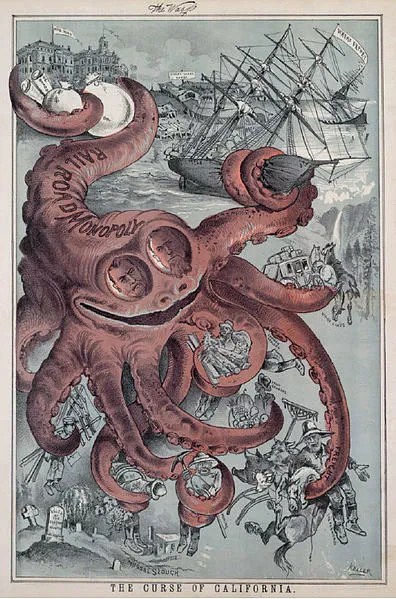
Unfortunately for them, Trump’s attack on Iran has exposed the US as a failing industrial power with an aging military. Because elites in failing empires always behave thusly, the capitalists have responded with unprecedented savagery. Trump assassinated the Iranian leadership while they were negotiating, and kidnapped Venezuela’s president and wife and stole their oil. Now he threatens to bomb Iran back to the “Stone Age”, while bragging about his ongoing piracy.
Trump is simply responding to elite stimuli. Foreign policy is driven by the capitalist nature of our country, leading the US to embrace a military-centric hyper-imperialism in response to a marked erosion of its economic and, financial power. Beyond the president and congress there is a deeper structure of power in the United States, where real authority derives from the ownership and control of capital. Our elite comprise an overlapping ownership and control over capital, production, and finance. They include institutional investors who control massive pools of assets, corporate executives who administer production and financial institutions that allocate credit.
They, not we, control a militarized state that enforces domestic and foreign supremacy for capital. To understand who rules America is not to identify a deep state. It is to recognize a structural reality–that economic power is afforded through the ownership of capital, control of finance, and management of production.
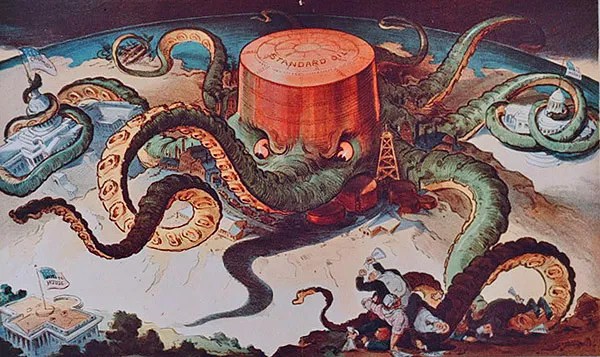
In Who Rules America?, William Murphy, details the hidden architecture of the ruling class–“This is why power in advanced capitalism often appears decentralized while functioning in a deeply coordinated way. It is not that someone is issuing orders from a hidden center. It is that the system itself produces alignment through its structure.
At its core, the ruling class is defined not by wealth alone, but by control over the strategic levers of economic life: investment, credit, production, and enforcement.
The role of the state in this system is often mischaracterized as either neutral arbitration or direct corporate capture. Both views miss the deeper structural function.
The state in advanced capitalism operates as a stabilizing apparatus for the reproduction of the system as a whole. It does not simply enforce laws; it manages the conditions under which capital accumulation remains viable over time.
This includes monetary policy, fiscal intervention, legal frameworks for property rights, and, crucially, the capacity for coercion through military and policing institutions. In moments of crisis, whether financial collapse, social unrest, or geopolitical conflict, the state absorbs shocks that private capital cannot manage alone.
Far from standing outside the economy, the state is deeply embedded within it. It provides the institutional continuity that allows capital to survive its own contradictions.”
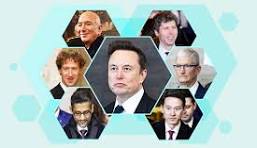
Trump’s Iranian adventure is certainly raising all sorts of contradictions. Meanwhile, there’s a changing of the capitalist guard, with the tech-bros making a play for primacy.
What’s clear is that no matter which faction comes out on top, elections and candidates have little to do with this architecture of power. Murphy says that “…elected officials occupy a specific and limited role. They are not sovereign decision-makers in the full sense often implied in public discourse. Political leadership functions primarily as a mechanism for managing legitimacy, mediating competing interests within capital, and translating systemic imperatives into publicly acceptable language.”
Might be something to keep in mind as the midterms approach, where we will be besieged with propaganda claiming it to be the most important election in American history.
Update: The new order materializes.
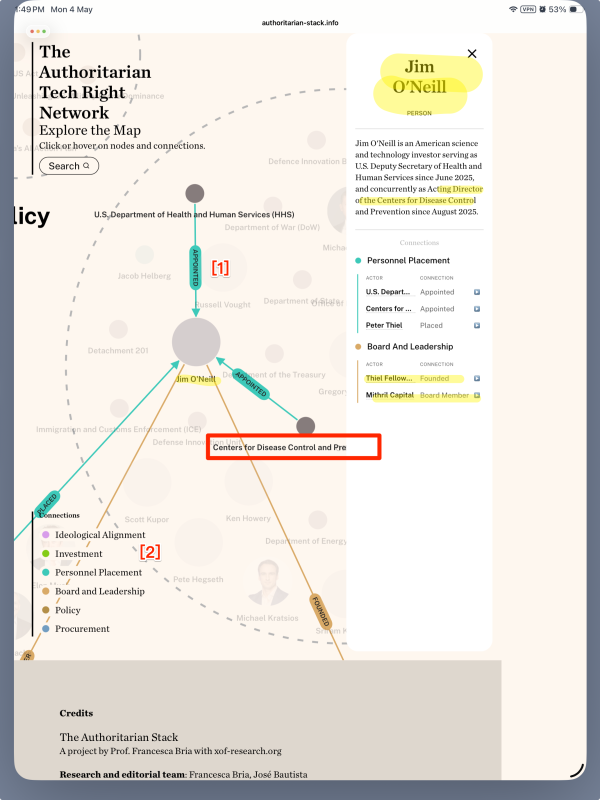
“How Tech Billionaires Are Building a Post-Democratic America — And Why Europe Is Next”
“Under the banner of “patriotic tech”, this new bloc is building the infrastructure of control—clouds, AI, finance, drones, satellites—an integrated system we call the Authoritarian Stack. It is faster, ideological, and fully privatized: a regime where corporate boards, not public law, set the rules.”

