
How do people develop their worldview so that they become resistant to examination, modification or change? I say this because I’m struck by the responses of fellow Americans when talking about politics, where they constantly repeat the talking-points of their respective news source. I’ve come to regretfully accept that they are creatures of our world-class propaganda system, and there’s little I can do to change their minds.
It’s the narrative. Humans are captive to stories, where we process our world through symbols and especially narrative.
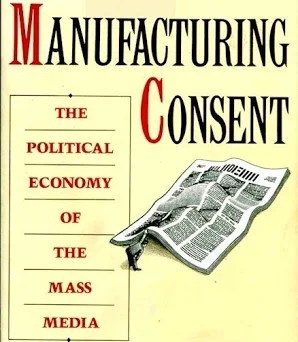
Social scientists recognized this early in the 20th Century and World War 1 provided a concrete example of how people could be controlled through advertising, public relations and propaganda. Americans were opposed to the war in Europe but President Wilson, who was beholden to the Wall Street bankers who’d provided loans to Britain and the rest of the Triple Entente, entered the war anyway. On the side of the Wall Street bankers debtor’s, I might add. This required changing Americans attitudes towards war and eliminating any vestige of pacifism or isolationism. Hence the creation of the Creel Commission, where social scientists were enlisted to manufacture consent, largely by depicting the Germans as bestial monsters.
The notable members of the Creel Commission consisted of social scientists and journalists–Harold Lasswell, Walter Lipman and Edward Barney’s, who went on to create the modern advertising and public relations industries that we’re familiar with. And of course the propaganda apparatus, which the America elite depend on to ensure acquiescence.

The power of narrative has only grown more important, especially in the age of social-media. Narrative has become the American empire’s most powerful weapon, even as the overpriced kinetic weapons produced by the military/industrial/complex prove suboptimal. As we have witnessed in the US’s multiple wars, especially the proxy war against Russia in Ukraine, narrative can be utilized effectively to support conventional military operations and those utilizing proxies and deniable paramilitary forces, military coercion, offensive cyber operations, and of course lawfare.
Established techniques, such as assassination, deception, economic coercion, espionage, theft of intellectual property and subversion gain potency through the clever use of cyber, digitized information and social media. Psychological insights into how these channels can be manipulated enhance their effectiveness.

Then there’s the tactic of omission, increasingly important to bad news coming out of Ukraine, where our erstwhile allies have established a archipelago of torture sites aimed at feeding Ukrainian citizens into the meat grinder.
But, never mind all of that, there’s been an election and we get to transition from overt fascism to the down-low Democrat version. Wait for it. “Alex Karp says he’s a lifelong Democrat — and Palantir’s products are ‘essentially progressive'” Business Insider
There’s method to the madness. Power does not rest in the Congress. It does not rest in the courts. It does not even rest in the imperial presidency. It rests in the hands of Wall Street financiers, Silicon Valley, private equity firms, the fossil fuel industry, the predatory health care and pharmaceutical giants, agribusinesses and, most of all, the war industry. All of these actors organize the ongoing narrative that their ownership and control of the country are the natural order of things and the show must go on.
That’s called narrative control. We are told that housing cannot be made affordable overnight, that poverty cannot be eradicated in a generation, that healthcare must operate within financial constraints, that wages cannot simply rise, that public services cannot be rebuilt without unaffordable outlay. Of course, all of these decisions are political. The money is always there for a nation with a sovereign currency. Think of the billions that magically appeared to bail out Wall Street or bomb Iran.

Accompanying this economic arrangement is a narrative designed to ensure that those who own the wealth retain the authority to determine how the rest of us are permitted to live, what we can expect from society and, ultimately, how much of our own existence we are allowed to control. The issue has never been whether our governments possess the resources, institutional capacity or legislative authority to fundamentally improve people’s lives. They demonstrably do. The question is whose interests they serve, who controls the resources we collectively produce.
However, I’m hopeful there’s another narrative that emerged in the wake of the midterm elections where numerous candidates ran on economic populism. Across battleground districts and deep-red states alike, a defiant new mode of Democratic populism performed shockingly well, challenging long-held assumptions about the party’s political center. These economic populists ran against Big Tech data centers, price gouging monopolies, Wall Street home takeovers, AI surveillance pricing, and corporate consolidation in medicine, agriculture, groceries and beyond, and voters responded.
Here’s former FTC Chair Lina Khan surmising the new landscape–“As newly elected state officials take the helm in coming months, they will have significant opportunity to use and activate all their tools to halt corporate abuse and make life better for working people.”
It sounds encouraging but if history has taught us anything it’s that progressive change that benefits ordinary people requires sustained protest, struggle and organization. In what is coming to be a theme–“power concedes nothing without a demand it never did and it never will.”


